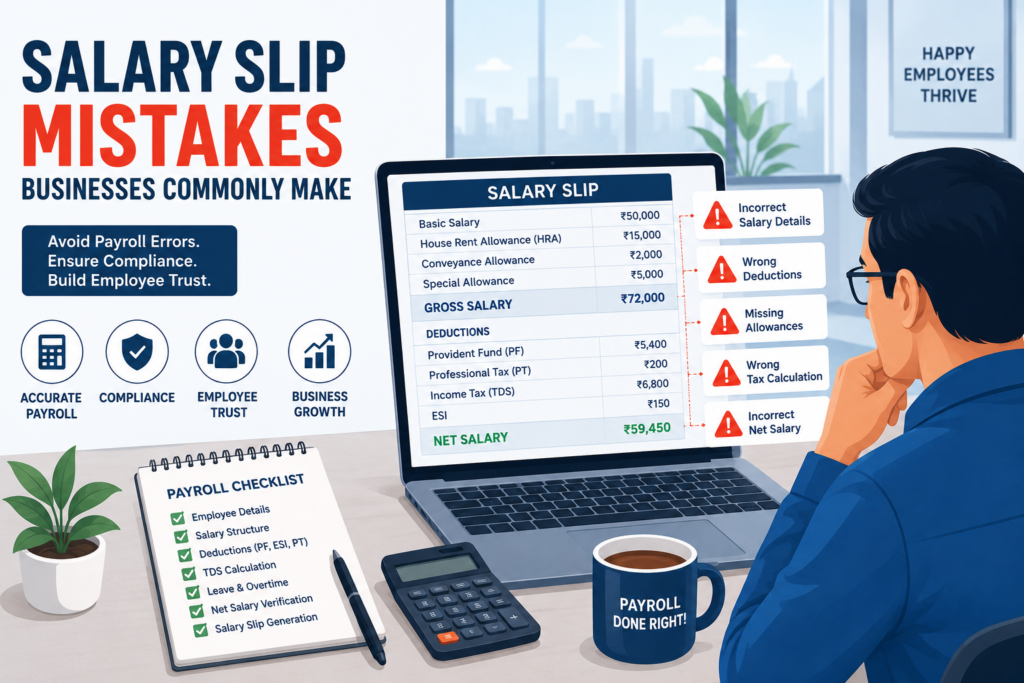
Salary Slip Mistakes Businesses Commonly Make
Managing payroll is one of the most critical responsibilities for any startup. While many businesses focus on paying salaries on time, they often overlook the accuracy of the salary slip. Even minor salary slip mistakes can create compliance issues, employee dissatisfaction, tax complications, and legal risks.
For Indian startups, maintaining accurate salary slips isn’t just a best practice—it’s an essential part of professional payroll management. This guide highlights the most common salary slip mistakes, explains their consequences, and provides practical tips to avoid them.
Why Salary Slips Matter for Indian Businesses
A salary slip serves as official proof of an employee’s earnings and deductions. Employees require it for:
- Applying for loans
- Income Tax Return (ITR) filing
- Visa applications
- Employment verification
- Rental agreements
- Financial planning
For employers, accurate salary slips demonstrate transparency, compliance, and professionalism.
Common Salary Slip Mistakes Businesses Make
1. Incorrect Employee Information
One of the most common salary slip mistakes is entering incorrect employee details.
What goes wrong?
- Misspelled employee names
- Wrong Employee ID
- Incorrect PAN or Aadhaar number
- Incorrect bank account details
- Wrong designation
Why it matters
These errors can delay tax filing, create payroll disputes, and reduce employee trust.
Best Practice
Always verify employee records before generating payroll.
2. Incorrect Salary Structure
Many startups fail to properly define salary components.
Common issues include:
- Wrong Basic Salary
- Missing House Rent Allowance (HRA)
- Incorrect Special Allowance
- Incorrect Conveyance Allowance
- Missing Medical Allowance
- Incorrect Gross Salary
An inaccurate salary structure can affect:
- Income Tax calculations
- Provident Fund (PF)
- Employee State Insurance (ESI)
- Gratuity calculations
3. Errors in Tax Deduction (TDS)
Incorrect Tax Deducted at Source (TDS) is another major salary slip mistake.
Businesses often:
- Deduct excess TDS
- Deduct lower TDS
- Ignore employee investment declarations
- Use outdated tax slabs
Consequences
- Employee tax notices
- Refund delays
- Compliance issues
- Employee dissatisfaction
4. Incorrect Provident Fund (PF) Calculation
Indian payroll compliance requires eligible employers to deduct PF correctly.
Common PF mistakes include:
- Wrong PF wages
- Incorrect employer contribution
- Incorrect employee contribution
- Missing PF deduction
These errors may result in penalties from the Employees’ Provident Fund Organisation (EPFO).
5. Missing Professional Tax (PT)
Professional Tax rules vary by state.
Businesses often:
- Forget PT deductions
- Deduct incorrect amounts
- Ignore state-specific regulations
Since Professional Tax is state-dependent, startups operating in multiple states should regularly review applicable rules.
6. Wrong Leave Deduction
Payroll software should accurately calculate:
- Paid Leave
- Casual Leave
- Sick Leave
- Loss of Pay (LOP)
Errors in attendance integration often lead to incorrect salary calculations.
Employees quickly notice these discrepancies, making this one of the most frequent payroll complaints.
7. Ignoring Overtime Payments
Some startups forget to include:
- Overtime
- Weekend work
- Holiday compensation
- Shift allowance
This results in inaccurate salary slips and employee disputes.
8. Incorrect Bonus or Incentive Entries
Variable pay should be clearly shown.
Common mistakes include:
- Missing sales incentives
- Incorrect performance bonus
- Wrong annual bonus calculation
- Duplicate incentive entries
Always verify incentive data before payroll processing.
9. Missing Salary Slip Generation
Some startups pay salaries without issuing salary slips.
This creates problems when employees need documentation for:
- Home loans
- Personal loans
- Visa processing
- Income proof
Issuing salary slips every month should be a standard HR practice.
10. Manual Payroll Calculation Errors
Excel spreadsheets increase the likelihood of payroll mistakes.
Typical manual errors include:
- Formula errors
- Copy-paste mistakes
- Duplicate deductions
- Wrong totals
As startups grow, manual payroll becomes increasingly difficult to manage accurately.
How Salary Slip Mistakes Affect Businesses
Ignoring payroll accuracy can lead to:
- Employee dissatisfaction
- Higher employee turnover
- Government penalties
- Tax notices
- Audit complications
- Damaged employer reputation
- Compliance violations
For startups, avoiding these risks is essential for sustainable growth.
Best Practices to Avoid Salary Slip Mistakes
Use Payroll Software
Automated payroll software minimizes human error and ensures accurate calculations.
Verify Employee Records Regularly
Review employee details before each payroll cycle to prevent inaccuracies.
Stay Updated on Compliance
Monitor changes to:
- Income Tax rules
- EPF regulations
- ESI requirements
- Professional Tax rates
- Labour laws
Review Salary Comhttps://vpassociatess.in/ponents
Ensure all salary components and deductions are correctly reflected before issuing salary slips.
Conduct Payroll Audits
Periodic payroll audits help identify and correct recurring issues before they become major problems.
Final Thoughts
For Indian startups, payroll accuracy is more than an administrative task—it builds employee trust and ensures legal compliance. Avoiding common salary slip mistakes protects your business from unnecessary disputes, penalties, and operational challenges.
By implementing strong payroll processes, using reliable payroll software, and staying updated with regulatory changes, startups can generate accurate salary slips every month and maintain a professional workplace.
Managing payroll is one of the most critical responsibilities for any startup.
What are the most common salary slip mistakes?
Common salary slip mistakes include incorrect employee details, inaccurate salary calculations, wrong tax deductions, missing PF or ESI contributions, and incorrect leave deductions.
Why is an accurate salary slip important?
An accurate salary slip helps employees with tax filing, loan applications, visa processing, and financial planning while ensuring payroll compliance.
Can salary slip mishttps://vpassociatess.in/takes lead to legal issues?
Yes. Incorrect deductions, missing statutory contributions, or payroll compliance errors can result in penalties, audits, and legal disputes.
Managing payroll is one of the most critical responsibilities for any startup.
Startups can avoid salary slip mistakes by using payroll software, verifying employee data, staying updated on tax regulations, and conducting regular payroll audits.
Is issuing a salary slip mandatory in India?
The requirement varies by state and applicable labor laws. However, issuing salary slips is widely considered a best practice and is often expected for compliance, transparency, and employee documentation needs.
Leave a Reply