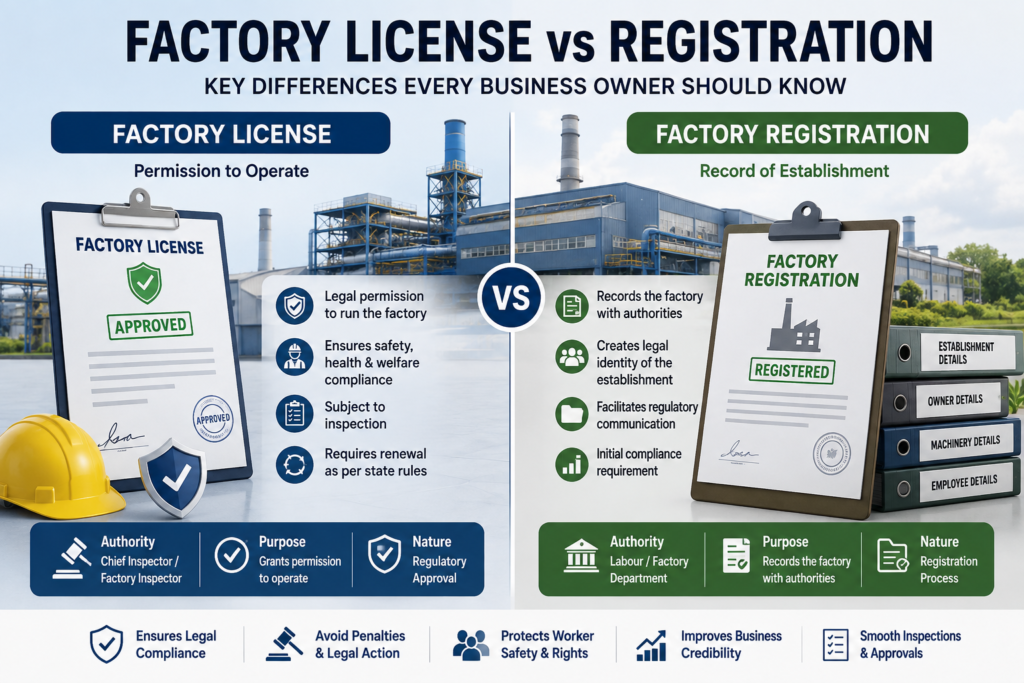
Understanding the difference between Factory License vs Registration is essential for every business owner involved in manufacturing or industrial operations. Many entrepreneurs mistakenly believe that factory registration and a factory license are the same, but they serve different legal and compliance purposes.
Whether you’re setting up a new manufacturing unit or expanding your existing operations, knowing when you need a factory registration and when you require a factory license can help you avoid penalties, ensure legal compliance, and keep your business running smoothly.
In this guide, we’ll explain the differences, eligibility, legal requirements, benefits, and application process to help you make the right decision.
What is Factory Registration?
Factory Registration is the process of registering a manufacturing establishment with the relevant labour or industrial authority under applicable state laws and the Factories Act (or the Occupational Safety, Health and Working Conditions Code, where implemented).
Registration creates an official record of the factory and is generally one of the initial compliance steps before operations begin.
Purpose of Factory Registration
- Establishes legal identity for the manufacturing unit
- Records employer and factory details
- Enables regulatory compliance
- Facilitates inspections and statutory reporting
What is a Factory License?
A Factory License is an official approval granted by the competent authority permitting a factory to legally operate after meeting prescribed safety, health, and welfare requirements.
Unlike registration, the license authorizes manufacturing activities subject to compliance with applicable regulations.
Purpose of a Factory License
- Legal authorization to operate a factory
- Ensures workplace safety compliance
- Protects employee welfare
- Demonstrates regulatory compliance
Factory License vs Registration: Major Differences
| Basis | Factory Registration | Factory License |
|---|---|---|
| Purpose | Records the factory with authorities | Grants permission to operate |
| Nature | Registration process | Regulatory approval |
| Objective | Compliance record | Legal operational authorization |
| Authority | Labour/Factory Department | Chief Inspector/Factory Inspector or competent authority |
| Renewal | May not require periodic renewal depending on state provisions | Usually requires renewal as per state rules |
| Inspection | Limited at registration stage | Often subject to inspection before or during licensing |
| Compliance | Initial legal requirement | Ongoing statutory compliance |
Who Needs Factory Registration?
Business owners operating manufacturing facilities that meet the applicable statutory thresholds should complete factory registration.
Common examples include:
- Manufacturing companies
- Engineering units
- Food processing industries
- Textile manufacturers
- Chemical industries
- Packaging units
- Pharmaceutical manufacturers
Who Needs a Factory License?
A Factory License is generally required where a manufacturing unit falls within the applicable legal definition of a factory under the relevant law.
Businesses commonly requiring a license include:
- Medium and large manufacturing plants
- Factories employing the prescribed number of workers
- Units using power-driven manufacturing processes
- Hazardous manufacturing industries
Benefits of Factory Registration
Why is Factory Registration Important?
- Builds legal credibility
- Facilitates statutory compliance
- Simplifies regulatory communication
- Supports business expansion
- Helps avoid legal disputes
Benefits of Obtaining a Factory License
Why Should Businesses Obtain a Factory License?
- Enables lawful factory operations
- Demonstrates compliance with labour laws
- Enhances worker safety
- Reduces legal risks
- Improves business credibility
- Helps during inspections and audits
Factory License vs Registration: Which One Do You Need?
The answer depends on your business structure, manufacturing process, number of workers, use of power, and the applicable state regulations.
In many cases:
- Registration is the initial compliance requirement.
- A Factory License becomes mandatory before https://vpassociatess.in/commencing manufacturing operations where the law requires it.
Consulting a compliance professional ensures your business satisfies all applicable legal requirements.
Common Mistakes Business Owners Make
Is Factory Registration Enough?
No. Registration alone may not authorize manufacturing operations if a factory license is legally required.
Can a Factory Operate https://vpassociatess.in/Without a License?
Operating without a required license can result in penalties, legal action, and possible closure orders.
Do Small Manufacturing Units Need a Factory License?
The requirement depends on statutory thresholds, workforce size, manufacturing process, and state-specific regulations.
Documents https://vpassociatess.in/Commonly Required
Although requirements vary by state, businesses are generally asked to provide:
- Identity and address proof
- Business registration documents
- Site plan/layout
- Ownership or lease documents
- Machinery details
- Employee information
- Safety compliance documents
- Environmental approvals (where applicable)
How to Apply for Factory Registration and License
- Determine whether your unit falls under the applicable legal provisions.
- Prepare the required documents.
- Submit the prescribed application to the relevant authority.
- Pay the applicable government fees.
- Facilitate inspection, if required.
- Receive registration and/or license upon approval.
Conclusion
Understanding Factory License vs https://vpassociatess.in/Registration is crucial for ensuring legal compliance and uninterrupted business operations. While factory registration establishes your manufacturing unit with the authorities, a factory license provides the legal authorization to operate.
Before starting manufacturing activities, carefully evaluate your legal obligations under the applicable central and state laws. Seeking professional compliance assistance can save time, reduce risks, and help your business remain compliant.
Leave a Reply