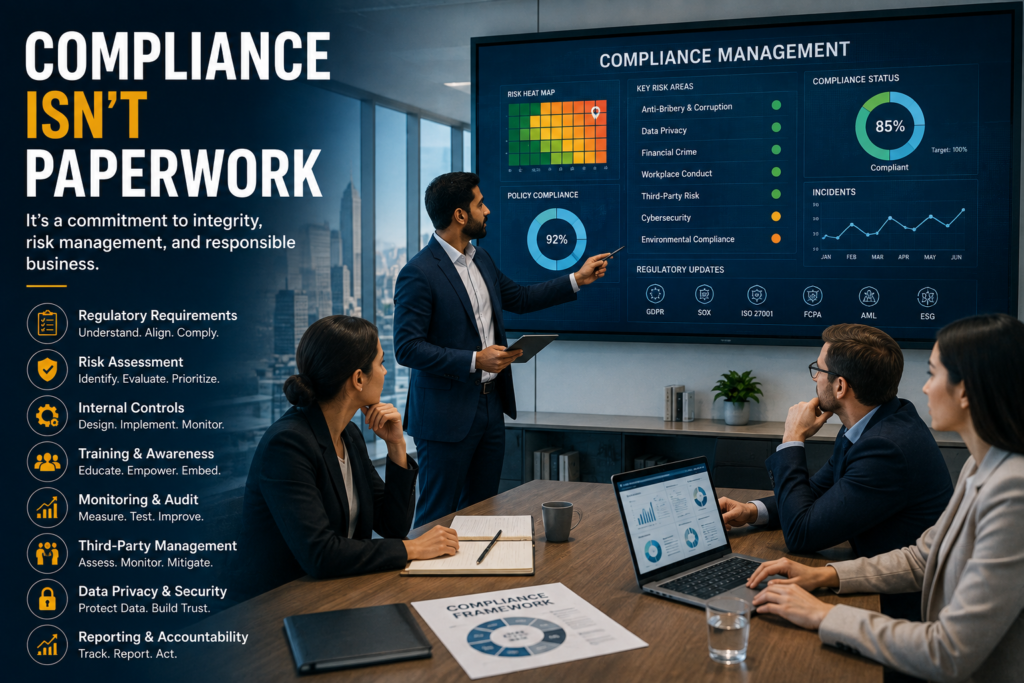
For many organizations, compliance is still treated as paperwork—policies to approve, forms to complete, documents to store, and checklists to tick before an audit.
But that approach misses the bigger picture.
Compliance isn’t paperwork. Compliance is a business function that protects an organization from legal, financial, operational, regulatory, and reputational risk.
A strong compliance program does more than prove that documents exist. It helps organizations understand their obligations, identify risks, monitor controls, respond to regulatory changes, and build a culture where responsible business practices become part of everyday decision-making.
For compliance officers, this shift is particularly important. The role is no longer simply about maintaining records for an audit. Modern compliance officers increasingly act as risk advisers, control owners, educators, investigators, and strategic partners to the business.
What Does “Compliance Isn’t Paperwork” Really Mean?
The statement “compliance isn’t paperwork” means that documentation is only one component of an effective compliance program.
Paperwork can demonstrate that a process exists. It cannot, by itself, prove that employees understand the process, that controls operate effectively, or that risks are being managed.
For example, an organization may have a beautifully written anti-bribery policy. If employees do not understand it, third parties are not properly screened, and potential violations are not investigated, the policy alone provides limited protection.
Effective compliance management connects four things:
- Regulatory requirements
- Business risks
- Internal controls
- Employee behavior
When these elements work together, compliance becomes part of how the organization operates rather than a separate administrative exercise.
Why Is Compliance More Than Documentation?
Documentation matters. Organizations need policies, procedures, evidence, training records, risk assessments, monitoring reports, and audit trails.
The problem begins when documentation becomes the objective instead of the evidence of an effective compliance process.
Can a company be compliant just because it has policies?
No.
Policies are important, but having a policy does not automatically mean that the organization is managing the underlying risk.
A practical compliance program should answer questions such as:
- What regulations apply to the organization?
- Which compliance risks are most significant?
- Who owns each risk?
- What controls are in place?
- Are those controls actually working?
- How are compliance breaches reported?
- How quickly are issues investigated?
- What happens when a control fails?
- How does management know whether compliance performance is improving?
These questions move compliance from paperwork to operational risk management.
What Does Effective Compliance Management Look Like?
Effective compliance management is a continuous process rather than an annual exercise.
A mature compliance framework typically includes:
How Do Compliance Officers Identify Regulatory Obligations?
The first step is understanding which laws, regulations, standards, contractual obligations, and internal requirements apply to the organization.
For global organizations, this can become complex because requirements may vary across jurisdictions, industries, products, and business activities.
A practical approach is to maintain a regulatory obligations register or compliance obligations framework that clearly identifies:
- Applicable requirements
- Relevant jurisdictions
- Responsible owners
- Required controls
- Monitoring activities
- Evidence requirements
- Review frequency
This creates visibility into what the organization actually needs to comply with.
How Should Compliance Risks Be Assessed?
Not every compliance obligation creates the same level of risk.
A compliance risk assessment helps organizations prioritize their resources by considering factors such as likelihood, potential impact, regulatory exposure, financial consequences, customer impact, and reputational damage.
For example, a global organization may identify significant exposure in areas such as:
- Anti-bribery and corruption
- Data protection and privacy
- Financial crime
- Sanctions and export controls
- Employment regulations
- Consumer protection
- Industry-specific regulation
- Third-party risk
The objective is not to create another spreadsheet. The objective is to understand where the organization is most vulnerable.
Why Should Compliance Be Connected to Business Operations?
Compliance becomes significantly more effective when it is built into business processes.
Instead of asking employees to complete compliance tasks separately, organizations can integrate controls into workflows.
For example:
Procurement + third-party due diligence
Rather than asking procurement teams to remember compliance requirements after selecting a supplier, compliance checks can become part of the vendor onboarding process.
Sales + anti-bribery controls
Instead of reviewing questionable transactions https://vpassociatess.in/after the fact, approval thresholds and risk checks can be integrated into sales processes.
Technology + privacy
Instead of reviewing privacy risks after launching a product, privacy considerations can be incorporated during product development.
This is the essence of operational compliance: compliance controls become part of how work is performed.
How Can Compliance Officers Move Beyond the Checklist?
Checklists are useful, but they should support professional judgment rather than replace it.
Is a compliance checklist enough for effective compliance?
No.
A checklist can confirm whether certain activities were completed. It does not necessarily show whether those activities were effective.
For example:
Checklist approach:
Employee training completed: Yes.
Risk-based approach:
Did employees understand the training?
Did high-risk employees receive role-specific training?
Were knowledge gaps identified?
Did employee behavior change?
Were subsequent compliance incidents reduced?
The second approach produces much more meaningful information.
A modern compliance officer should therefore focus not only on completion but also on effectiveness.
What Role Does Compliance Monitoring Play?
Compliance monitoring helps determine whether controls are operating as intended.
Monitoring can include:
- Transaction reviews
- Control testing
- Employee surveys
- Case reviews
- Data analysis
- Third-party monitoring
- Policy exception analysis
- Regulatory change tracking
- Internal assessments
The goal is to identify weaknesses before they become significant compliance incidents.
How is compliance https://vpassociatess.in/monitoring different from an audit?
An audit generally provides a structured assessment of controls, processes, or financial information against defined criteria.
Compliance monitoring can be more continuous and operational. It may help compliance teams identify emerging issues throughout the year.
Both can play important roles in a broader compliance management framework.
Why Is Evidence Still Important If Compliance Isn’t Paperwork?
Saying compliance isn’t paperwork does not mean documentation is unnecessary.
Evidence remains critical.
Organizations may need to demonstrate that they:
- Identified applicable requirements
- Assessed compliance risks
- Implemented appropriate controls
- Trained relevant employees
- Monitored compliance activities
- Investigated issues
- Corrected deficiencies
- Reported significant matters appropriately
The difference is that documentation should prove that an effective process exists rather than substitute for the process itself.
Good documentation tells a story:
Risk identified → control implemented → https://vpassociatess.in/control operated → result monitored → issue corrected.
That is much more valuable than simply maintaining a folder full of policies.
How Does Technology Improve Compliance Management?
Technology can help compliance teams move away from manual administration and focus more time on analysis and risk management.
A modern compliance management system may help organizations manage:
Leave a Reply