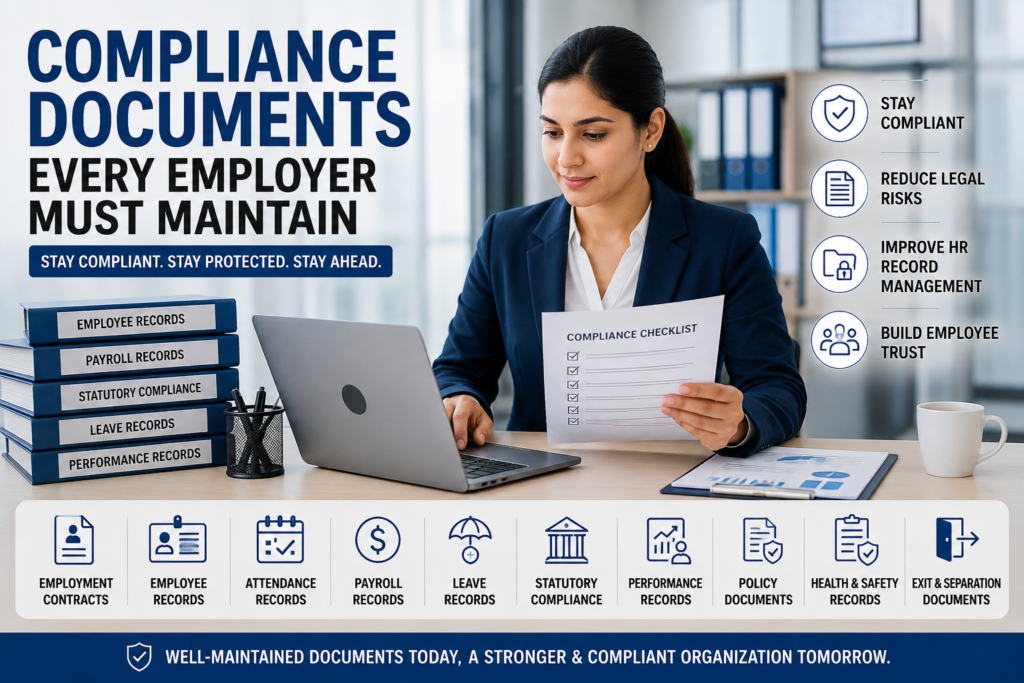
Why Compliance Documents Matter for Every Employer
In today’s highly regulated business environment, maintaining accurate compliance documents every employer must maintain is not just a legal requirement—it’s a fundamental part of effective HR record management. Proper documentation protects organizations from legal disputes, ensures regulatory compliance, supports audits, and builds employee trust.
Whether you’re managing a startup or a large enterprise, HR professionals play a critical role in maintaining records that comply with employment laws while streamlining organizational processes.
What Are Compliance Documents?
Compliance documents are official records that demonstrate an employer’s adherence to labor laws, workplace regulations, employee rights, and statutory obligations. These documents serve as evidence during government inspections, labor disputes, and internal audits.
Effective HR record management ensures these documents remain accurate, updated, confidential, and easily accessible.
Compliance Documents Every Employer Must Maintain
1. Employee Offer Letter & Employment Contract
Every employee should receive a formal offer letter followed by an employment contract outlining:
- Job title
- Compensation
- Benefits
- Working hours
- Leave policies
- Confidentiality clauses
- Termination conditions
These documents establish the legal employment relationship.
2. Employee Personal Records
Every employer should maintain:
- Identity proof
- Address proof
- Educational certificates
- Experience documents
- Passport-sized photographs
- Emergency contact information
Accurate employee records simplify verification and statutory compliance.
3. Employee Attendance Records
Attendance records should include:
- Daily attendance
- Overtime hours
- Shift schedules
- Remote work logs
- Leave balances
Digital attendance systems significantly improve HR record management and compliance.
4. Payroll Records
Payroll documentation should include:
- Salary registers
- Payslips
- Bonus records
- Incentive payments
- Tax deductions
- Bank transfer details
Maintaining payroll records helps emphttps://vpassociatess.in/loyers demonstrate compliance during financial and labor audits.
5. Leave Records
Organizations should maintain complete records of:
- Casual leave
- Sick leave
- Earned leave
- Maternity leave
- Paternity leave
- Unpaid leave
Proper leave documentation prevents disputes and ensures compliance with labor laws.
6. Statutory Compliance Documents
Depending on applicable regulations, employers may need to maintain records relating to:
- Employee provident fund
- Employee insurance
- Professional tax
- Labor welfare contributions
- Gratuity records
These statutory records are among the most important compliance documents every employer must maintain.
7. Employee Performance Records
Performance management documents include:
- Goal-setting forms
- Performance reviews
- Promotion records
- Training reports
- Improvement plans
Maintaining these records supports fair employment decisions.
8. Disciplinary Acthttps://vpassociatess.in/ion Records
HR departments should securely maintain documentation relating to:
- Warning letters
- Show-cause notices
- Investigation reports
- Suspension orders
- Disciplinary committee findings
These records protect employers during employment disputes.
9. Workplace Policy Documents
Every employer should maintain updated versions of:
- Employee handbook
- Code of conduct
- Anti-harassment policy
- Equal opportunity policy
- Data privacy policy
- Remote work policy
Employees should acknowledge receipt of these policies.
10. Health & Sahttps://vpassociatess.in/fety Records
Where applicable, employers should maintain:
- Safety training records
- Incident reports
- Medical examination reports
- Emergency evacuation procedures
- Workplace inspection reports
These documents demonstrate compliance with workplace safety regulations.
11. Training & Certification Records
Training documehttps://vpassociatess.in/ntation should include:
- Compliance training
- Workplace safety training
- Cybersecurity awareness
- Professional development
- Certification renewals
These records support organizational compliance and employee development.
12. Separation & Exit Documents
When employees leave, employers should maintain:
- Resignation letters
- Exit interviews
- Full & final settlement records
- Experience letters
- Relieving letters
- Asset return forms
Proper documentation minimizes legal risks after employment ends.
Best Practices for HR Rehttps://vpassociatess.in/cord Management
How long should employers retain compliance documents?
Retention periods vary depending on applicable laws and business requirements. Employers should establish a documented retention policy and regularly review legal obligations for their jurisdiction.
Why should HR digitize compliance documents?
Digital HR record management offers:
- Faster retrieval
- Enhanced security
- Automated backups
- Audit readiness
- Reduced paperwork
- Better compliance tracking
How can employers improve compliance documentation?
Employers should:
- Conduct regular document audits.
- Use standardized HR templates.
- Implement secure document management systems.
- Restrict access to confidential records.
- Schedule periodic compliance reviews.
- Train HR teams on documentation requirements.
Common Mistakes Employers Should Avoid
- Missing employee documentation
- Incomplete payroll records
- Outdated workplace policies
- Poor document retention practices
- Manual filing without backups
- Lack of employee acknowledgments
- Delayed compliance updates
Avoiding these issues strengthens compliance and reduces legal exposure.
Conclusion
Maintaining the compliance documents every employer must maintain is essential for legal compliance, operational efficiency, and effective HR record management. Well-organized documentation supports audits, protects against disputes, and helps HR professionals manage employee records with confidence.
Organizations that invest in robust HR record management systems and regularly review their compliance documentation are better positioned to meet regulatory requirements while fostering a transparent and well-governed workplace.
Leave a Reply