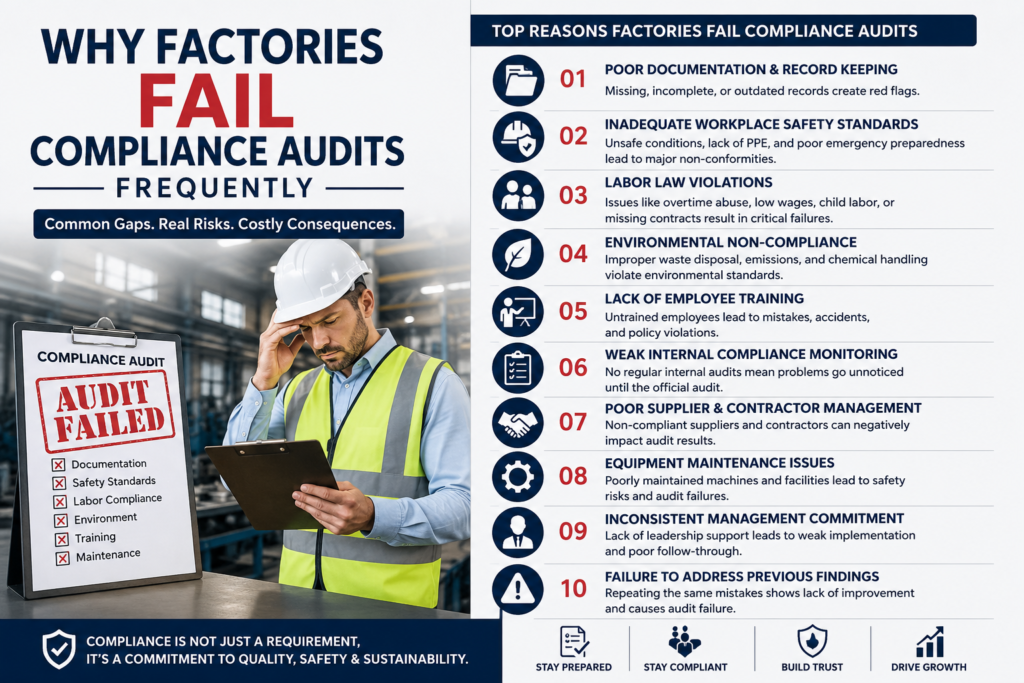
Compliance audits have become an essential part of modern manufacturing. Whether you’re supplying global brands or serving local markets, meeting industry regulations is no longer optional. Compliance audits ensure factories operate ethically, safely, and in accordance with environmental and labor standards.
However, many factories continue to fail compliance audits, leading to financial losses, damaged reputations, canceled contracts, and legal consequences. Understanding the common reasons behind these failures is the first step toward building a compliant and sustainable manufacturing operation.
In this article, we’ll explore why factories frequently fail compliance audits and how businesses can proactively avoid these costly mistakes.
1. Poor Documentation and Record Keeping
One of the leading reasons factories fail compliance audits is incomplete or inaccurate documentation.
Auditors require evidence for every compliance process, including:
- Employee records
- Payroll documentation
- Attendance registers
- Safety training records
- Equipment maintenance logs
- Environmental monitoring reports
Missing or outdated records raise immediate concerns about operational transparency and compliance.
Solution:
Implement a digital document management system and regularly update all compliance-related records.
2. Inadequate Workplace Safety Standards
Worker safety is a critical focus during compliance audits.
Common violations include:
- Blocked emergency exits
- Missing fire extinguishers
- Lack of PPE (Personal Protective Equipment)
- Unsafe machinery
- Poor electrical maintenance
- Inadequate emergency evacuation plans
Even minor safety issues can result in major audit findings.
Solution:
Conduct monthly internal safety inspections and provide regular safety training for employees.
3. Labor Law Violations
Labor compliance is among the most scrutinized audit areas.
Typical issues include:
- Excessive overtime
- Underpayment of wages
- Missing employment contracts
- Child labor concerns
- Forced labor indicators
- Inaccurate attendance records
These violations can severely impact a factory’s credibility and supplier relationships.
Solution:
Ensure HR policies align with local labor laws and international standards such as SA8000 and ILO guidelines.
4. Environmental Non-Compliance
Manufacturing facilities often fail audits due to poor environmental management.
Common issues include:
- Improper waste disposal
- Excessive emissions
- Untreated wastewater
- Hazardous chemical storage
- Lack of pollution control measures
Environmental violations not only fail audits but may also result in regulatory penalties.
Solution:
Adopt environmental management practices aligned with ISO 14001 and monitor environmental performance regularly.
5. Lack of Employee Training
Even well-designed compliance systems can fail if employees don’t understand them.
Workers may unknowingly violate procedures because they have never received proper training.
Training should cover:
- Safety procedures
- Emergency response
- Workplace ethics
- Anti-harassment policies
- Environmental responsibilities
- Machine operating procedures
Solution:
Schedule periodic training sessions and maintain attendance records for every program.
6. Weak Internal Compliance Monitoring
Many factories prepare only when an external audit is announced.
This reactive approach often exposes long-standing compliance gaps.
Without internal audits, management remains unaware of problems until it’s too late.
Solution:
Conduct quarterly internal compliance audits using the same checklist as third-party auditors.
7. Poor Supplier and Contractor Management
Compliance responsibilities often extend beyond the factory itself.
Suppliers and contractors who fail to meet standards can negatively affect your audit results.
Examples include:
- Unethical sourcing
- Poor labor practices
- Missing certifications
- Unsafe transportation methods
Solution:
Evaluate suppliers regularly and require compliance documentation before partnerships continue.
8. Equipment Maintenance Issues
Faulty or poorly maintained machinery creates both safety and operational risks.
Auditors frequently identify:
- Missing maintenance schedules
- Broken safety guards
- Calibration failures
- Oil leaks
- Electrical hazards
Solution:
Implement preventive maintenance schedules and document every inspection.
9. Inconsistent Managhttps://vpassociatess.in/ement Commitment
Compliance cannot be delegated solely to the quality department.
Factories often fail because senior management does not actively support compliance initiatives.
Without leadership involvement:
- Policies are ignored
- Budgets remain insufficient
- Employee participation declines
- Corrective actions are delayed
Solution:
Build a compliance-focused culture where leadership actively participates in audits and improvement initiatives.
10. Failure to Address Prevhttps://vpassociatess.in/ious Audit Findings
One of the fastest ways to fail a compliance audit is repeating the same non-conformities.
Auditors carefully review whether previous corrective actions have been effectively implemented.
Recurring issues suggest ineffective management systems.
Solution:
Track every corrective action, assign responsibilities, set deadlines, and verify completion before the next audit.
Best Practices to Pass Cohttps://vpassociatess.in/mpliance Audits
Factories can significantly improve audit performance by adopting these best practices:
- Maintain accurate documentation.
- Conduct regular internal audits.
- Train employees consistently.
- Strengthen workplace safety.
- Monitor environmental compliance.
- Review labor law requirements regularly.
- Digitize compliance records.
- Engage leadership in compliance initiatives.
- Monitor supplier compliance.
- Continuously improve through corrective actions.
Benefits of Strong Comphttps://vpassociatess.in/liance Management
Achieving compliance isn’t just about passing audits—it delivers long-term business value.
Benefits include:
- Improved customer trust
- Better workplace safety
- Increased operational efficiency
- Reduced legal risks
- Stronger supplier relationships
- Higher employee satisfaction
- Greater access to international markets
- Enhanced brand reputation
Compliance becomes a competitive advantage when integrated into everyday operations.
Conclusion
Factories rarely fail compliance audits because of a single issue. Instead, failures usually result from multiple small gaps across documentation, safety, labor practices, environmental management, and internal controls.
The good news is that these challenges are preventable. By building a proactive compliance culture, investing in employee training, maintaining accurate records, and conducting regular internal audits, manufacturers can consistently meet audit requirements and strengthen their position in the global supply chain.
Compliance should not be viewed as an annual event but as an ongoing commitment to operational excellence. Factories that embrace this mindset are far more likely to pass audits, earn customer confidence, and achieve sustainable business growth.
:::
For stronger search performance, this article can also be optimized with target keywords, internal linking suggestions, a meta title, meta description, FAQ schema, and an SEO-friendly URL slug.
Leave a Reply