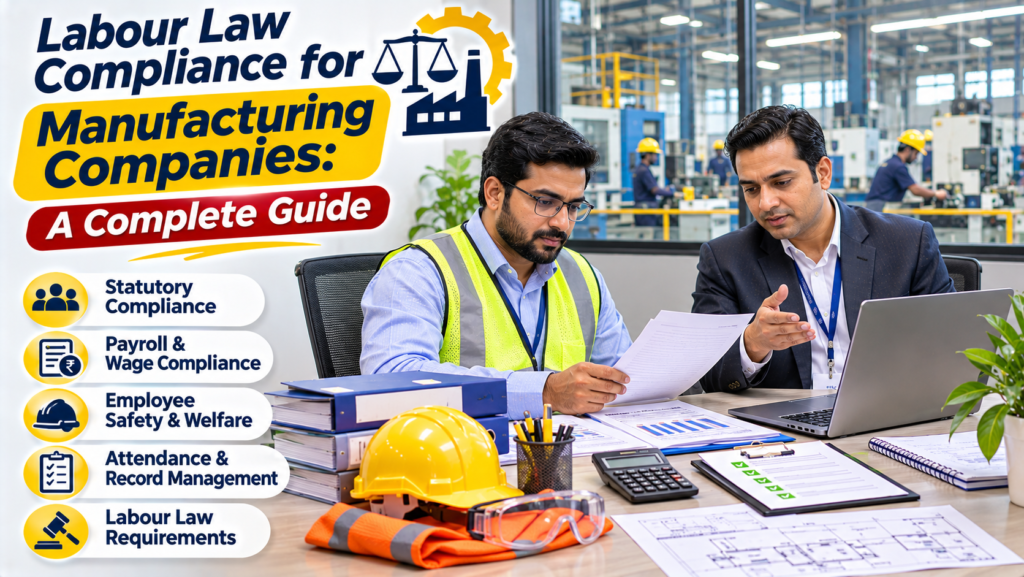
Running a manufacturing company in India involves more than managing production, machinery, raw materials, and supply chains. Employers must also follow applicable labour laws, maintain employee records, provide safe working conditions, manage statutory contributions, and complete required registrations and filings.
For manufacturing units, labour law compliance is particularly important because their operations may involve factory premises, production workers, contract labour, machinery, hazardous processes, shift arrangements, and workplace safety requirements.
A structured approach to labour law compliance for manufacturing companies helps employers understand their legal responsibilities, organise HR processes, and identify potential compliance gaps before they become serious problems.
India’s four Labour Codes came into effect on 21 November 2025, consolidating 29 central labour laws into four broad frameworks. These include the Code on Wages, the Industrial Relations Code, the Code on Social Security, and the Occupational Safety, Health and Working Conditions Code. Central Rules were subsequently notified in May 2026. Manufacturing companies must also check applicable state rules, notifications, transitional provisions, and industry-specific requirements.
This guide explains the important labour law obligations, factory-related requirements, employee statutory compliance activities, and practical steps manufacturing businesses should consider.
What Is Labour Law Compliance for Manufacturing Companies?
Labour law compliance refers to following the legal requirements governing employment, wages, social security, workplace safety, working conditions, and employee welfare.
Manufacturing companies must establish processes to ensure that employees receive applicable statutory benefits and that workplace operations follow relevant legal standards.
Depending on the nature and size of the establishment, compliance responsibilities may include:
- Factory registration and licensing.
- Approval of factory building plans, wherever required.
- Employee appointment documentation.
- Minimum wages and timely wage payments.
- Working hours and overtime management.
- Weekly rest and leave records.
- Provident Fund (PF) compliance.
- Employees’ State Insurance (ESI) compliance.
- Contract labour management.
- Workplace health and safety.
- Employee welfare facilities.
- Accident reporting and record maintenance.
- Bonus and gratuity obligations.
- Maternity-related benefits.
- Prevention of workplace sexual harassment.
- Statutory registers and returns.
Not every requirement applies identically to every manufacturing unit. Applicability depends on factors such as workforce strength, manufacturing processes, establishment classification, location, and relevant government notifications.
Understanding the Four Labour Codes Applicable to Manufacturing Units
The four Labour Codes provide the central framework for several important employment-related responsibilities.
Manufacturing companies should understand how each Code affects their operations.
1. Code on Wages, 2019
The Code on Wages deals with important wage-related responsibilities.
Manufacturing employers should review:
- Minimum wage requirements.
- Timely payment of wages.
- Permissible deductions.
- Overtime wage requirements.
- Equal remuneration principles.
- Statutory bonus provisions, where applicable.
- Wage records and related documentation.
Employers must ensure that employees receive wages according to applicable government notifications and statutory requirements.
2. Industrial Relations Code, 2020
The Industrial Relations Code covers matters relating to industrial employment and workplace relations.
Relevant areas may include:
- Trade union-related provisions.
- Industrial dispute resolution.
- Standing orders, where applicable.
- Grievance redressal mechanisms.
- Lay-off and retrenchment provisions.
- Closure-related requirements.
- Worker reskilling fund obligations in applicable cases.
Manufacturing companies should understand the requirements applicable to their workforce size and industrial establishment category before making major employment-related decisions.
3. Code on Social Security, 2020
The Code on Social Security brings together several social security-related provisions.
Important areas for manufacturing employers include:
- Employees’ Provident Fund.
- Employees’ State Insurance.
- Gratuity.
- Maternity benefits.
- Employee compensation.
- Other applicable social security provisions.
Companies should review employee eligibility, contribution calculations, registration requirements, and statutory payment responsibilities.
4. Occupational Safety, Health and Working Conditions Code, 2020
This Code is particularly important for manufacturing companies because it addresses workplace health, safety, and working conditions.
Relevant responsibilities may include:
- Establishment registration.
- Health and safety arrangements.
- Working conditions.
- Welfare facilities.
- Working hours and leave.
- Employer responsibilities towards workers.
- Contractor and contract labour requirements.
- Accident reporting.
- Safety measures for specified operations.
Manufacturing employers should review the applicable rules and standards according to their processes, workforce, and workplace risks.
Factory Licence Requirements for Manufacturing Companies
Factory registration and licensing are important parts of manufacturing establishment compliance.
Before starting or expanding factory operations, businesses should determine whether their premises fall within the applicable factory definition and what approvals are required.
Under the Occupational Safety, Health and Working Conditions Code, 2020, the general factory definition covers premises where a manufacturing process is carried out and the prescribed worker threshold is met. The threshold under the Code is generally 20 workers where manufacturing is carried out with the aid of power and 40 workers where it is carried out without the aid of power, subject to the Code’s provisions and applicable notifications.
Manufacturers should not rely on workforce numbers alone without checking the complete legal definition and any relevant exemptions or notifications.
Important Factory Registration and Licensing Activities
Depending on the establishment and applicable state procedures, the process may involve:
1. Factory Plan Approval
Manufacturers may need to submit building plans, layouts, machinery arrangements, and other prescribed information for approval before establishing or making specified changes to factory premises.
2. Factory Registration
Eligible establishments must complete the applicable registration process with the designated authority.
3. Factory Licence
Where required, the employer must obtain the appropriate factory licence and ensure that it remains valid according to applicable conditions.
4. Renewal and Modification
Changes in production activities, machinery, premises, workforce, or other prescribed particulars may require updates, permissions, or modifications to existing approvals.
5. Supporting Documentation
The company may need to maintain establishment details, building plans, machinery information, worker records, and other documents required by the relevant authority.
Manufacturers operating in Haryana should check the latest requirements through the Haryana Labour Department and applicable government portals before beginning or modifying operations.
Factory Compliance Checklist for Manufacturing Units
A practical factory compliance checklist helps employers track important statutory and operational responsibilities.
The following areas should be reviewed regularly.
1. Establishment Registration and Licensing
- Verify whether the premises fall within the applicable factory definition.
- Review factory registration requirements.
- Obtain applicable approvals and licences.
- Check licence validity and renewal requirements.
- Update relevant details after changes in operations.
- Maintain copies of approvals and official acknowledgements.
2. Employee Appointment and Documentation
Manufacturing companies should maintain accurate employment records.
Important documents may include:
- Appointment letters.
- Employment agreements, where applicable.
- Employee identity and contact information.
- Job descriptions.
- Wage and salary details.
- Employee nomination records.
- Attendance and leave records.
- Employee joining and exit documents.
- Applicable statutory declarations.
Employers should also ensure that workers receive the appointment documentation required under the applicable legal framework.
3. Minimum Wages and Salary Payments
Manufacturers must ensure that employees receive at least the applicable minimum wages.
Wage requirements may vary according to:
- State and geographical area.
- Skill classification.
- Nature of employment.
- Applicable wage notification.
- Relevant industry or establishment category.
Companies operating in Haryana should review the minimum wage notification effective from 1 April 2026 and any subsequent revisions.
Employers should also maintain accurate wage calculations, payment records, and wage slips.
4. Working Hours and Overtime
Production operations often involve multiple shifts and overtime requirements.
Employers should maintain records of:
- Daily working hours.
- Shift timings.
- Weekly rest periods.
- Overtime hours.
- Overtime payments.
- Holidays and applicable leave.
- Shift-related employee arrangements.
Working hours and overtime must follow the applicable legal limits and prescribed payment requirements.
5. PF and ESI Compliance for Factories
Eligible manufacturing establishments must manage social security contributions and related employee records.
Provident Fund compliance may include:
- Reviewing establishment coverage.
- Registering eligible employees.
- Verifying UAN details.
- Checking applicable wage calculations.
- Reviewing employee and employer contributions.
- Filing monthly contribution information.
- Depositing contributions within prescribed timelines.
- Maintaining challans and supporting records.
EPFO coverage generally applies to establishments employing 20 or more employees, subject to the applicable provisions and notifications.
ESI compliance may include:
- Reviewing establishment coverage.
- Registering eligible employees.
- Verifying insurance details.
- Checking applicable wage limits and contribution calculations.
- Updating employee joining and exit information.
- Filing contribution details.
- Depositing contributions within prescribed timelines.
Under the implemented Social Security Code framework, mandatory ESI coverage generally applies to establishments employing more than 10 employees, with additional provisions for hazardous or life-threatening occupations and voluntary coverage in specified circumstances.
Manufacturers should verify current applicability, contribution rates, wage definitions, and procedural requirements before filing.
Employee Statutory Compliance in Manufacturing Units
Employee statutory compliance involves more than PF and ESI contributions. Manufacturing employers must also review several other employee-related responsibilities.
1. Bonus Compliance
Eligible employees may be entitled to statutory bonus under applicable provisions.
Employers should review eligibility, applicable wage conditions, calculation methods, payment requirements, and supporting records.
Bonus-related obligations should be assessed according to the applicable law and employee category.
2. Gratuity Compliance
Gratuity is an important statutory employee benefit.
Manufacturers should maintain accurate employee service records and review gratuity eligibility and liabilities.
Important activities include:
- Maintaining employee joining dates.
- Updating service records.
- Reviewing applicable wage calculations.
- Maintaining nomination information.
- Processing eligible gratuity claims.
- Completing payments within prescribed timelines.
3. Maternity Benefits
Manufacturing companies must follow applicable maternity-related requirements.
HR teams should maintain appropriate records of leave applications, employee eligibility, benefits, and other applicable entitlements.
Employers should also review workplace arrangements and ensure that maternity-related benefits are administered without unlawful discrimination.
4. Workplace Sexual Harassment Prevention
Companies must maintain appropriate mechanisms to prevent and address workplace sexual harassment.
Under the POSH framework, establishments with 10 or more employees are generally required to constitute an Internal Committee.
Relevant responsibilities include:
- Constituting the Internal Committee.
- Following prescribed composition requirements.
- Displaying relevant workplace information.
- Conducting awareness and sensitisation activities.
- Maintaining complaint-handling procedures.
- Preserving confidentiality.
- Completing applicable annual reporting.
Manufacturing employers should ensure that workplace policies and reporting procedures are accessible to employees across shifts and departments.
Workplace Health and Safety Compliance
Workplace safety is one of the most important areas of industrial labour law regulations.
Manufacturing environments may involve heavy machinery, electrical systems, chemicals, heat, dust, noise, material handling, and other occupational risks.
Employers should identify workplace hazards and establish suitable safety procedures.
Important Factory Safety Responsibilities
1. Machinery Safety
Machinery should have suitable safeguards, protective devices, and operating procedures. Employees should receive appropriate instructions before operating equipment.
2. Personal Protective Equipment
Depending on workplace risks, workers may require helmets, gloves, safety shoes, eye protection, hearing protection, respiratory equipment, or other suitable protective equipment.
3. Fire and Emergency Preparedness
Manufacturing units should maintain appropriate fire prevention arrangements, emergency exits, evacuation procedures, and relevant emergency equipment.
4. First-Aid Arrangements
Suitable first-aid facilities and trained personnel should be available according to applicable requirements.
5. Safety Training
Employees should receive relevant training about machinery operation, workplace hazards, emergency procedures, and safe working practices.
6. Accident Reporting
Companies should maintain records of workplace accidents and dangerous occurrences and complete the required reporting to designated authorities.
7. Health and Welfare Facilities
Employers should review applicable requirements relating to drinking water, sanitation, washing facilities, rest areas, canteens, and other welfare arrangements.
The exact facilities required may depend on the establishment’s workforce, operations, and applicable rules.
Contract Labour Compliance in Manufacturing Companies
Many manufacturing units use contractors for housekeeping, loading and unloading, security, maintenance, packaging, and other operational activities.
Employers should understand that outsourcing work does not automatically remove all statutory responsibilities.
Depending on the applicable provisions, compliance may involve:
- Principal employer registration.
- Contractor licensing.
- Contractor workforce records.
- Employment and wage documentation.
- Attendance and working-hour records.
- PF and ESI verification.
- Wage payment monitoring.
- Applicable welfare arrangements.
- Contractor agreement documentation.
Manufacturing companies should obtain relevant statutory records and payment evidence from contractors at regular intervals.
They should also verify that contractor-related responsibilities are clearly defined and monitored.
Monthly and Annual Compliance Activities for Factories
A compliance calendar helps manufacturing companies manage recurring responsibilities.
| Frequency | Important Compliance Activities |
|---|---|
| Monthly | Attendance and leave verification |
| Monthly | Payroll processing and wage payments |
| Monthly | PF contribution review and filing, where applicable |
| Monthly | ESI contribution review and filing, where applicable |
| Monthly | Overtime and wage record verification |
| Monthly | Contractor workforce and payment review |
| Quarterly | Applicable salary TDS statements |
| Periodically | Minimum wage notification review |
| Periodically | Workplace safety inspections |
| Annually | Applicable statutory returns |
| Annually | HR and employee documentation review |
| Annually | Safety training and awareness review |
| Annually | Applicable POSH reporting |
| Event-based | Accident reporting and required notifications |
| Event-based | Employee joining, exit, and benefit processing |
| Event-based | Licence changes and establishment modifications |
The frequency and due dates must be checked against the applicable Central and State rules. Companies should avoid using a generic compliance calendar without first identifying their actual statutory obligations.
Common Labour Law Compliance Mistakes Manufacturing Companies Should Avoid
Even established manufacturing businesses can face compliance gaps when HR and factory administration processes are not reviewed regularly.
Some common mistakes include:
Using outdated wage rates: Companies may continue using old wage structures even after government revisions.
Ignoring contractor compliance: Employers may fail to verify contractor employee records and statutory contribution evidence.
Maintaining incomplete attendance records: Incorrect working-hour and overtime records can create wage and compliance-related problems.
Delaying statutory contributions: Late PF or ESI payments may lead to additional financial and legal consequences.
Allowing licences to expire: Missing renewal or modification requirements can create operational complications.
Neglecting workplace safety: Inadequate training, missing protective equipment, or poor machinery safeguards can expose workers to unnecessary risks.
Not updating employee documentation: Missing appointment letters, wage records, or employee details can create problems during inspections and audits.
Ignoring legal updates: Changes in labour codes, state rules, wage notifications, and filing procedures should be reviewed regularly.
How to Improve Factory HR Compliance
Manufacturing companies can make their compliance processes more organised by following a structured approach.
Step 1: Identify Applicable Requirements
Review the nature of manufacturing operations, employee strength, establishment classification, and applicable Central and State laws.
Step 2: Prepare a Compliance Calendar
Create a calendar covering monthly, quarterly, annual, and event-based activities.
Step 3: Assign Responsibility
Clearly allocate responsibilities to HR, payroll, finance, factory administration, safety teams, and external consultants.
Step 4: Maintain Digital Records
Organise employee files, payroll reports, statutory challans, licences, returns, and other supporting documents in a secure system.
Step 5: Verify Contractor Compliance
Regularly collect and review relevant records from contractors and service providers.
Step 6: Conduct Internal Compliance Audits
Review documents, payments, registrations, safety arrangements, and statutory filings to identify gaps.
Step 7: Monitor Legal Updates
Track changes in applicable labour laws, Haryana Government notifications, minimum wages, and statutory filing procedures.
Labour Law Compliance Support for Manufacturing Companies in Sonipat
Sonipat and its surrounding areas have several industrial and manufacturing locations where businesses may need assistance with employee documentation, factory-related compliance, payroll, and statutory responsibilities.
Manufacturing units operating in Rai Industrial Area, Kundli Industrial Area, Barhi Industrial Area, IMT Kharkhoda, and Murthal Industrial Area should review their compliance requirements according to their manufacturing processes, workforce strength, and establishment category.
Businesses in nearby locations such as Model Town Sonipat, Sector 7, Sector 8, Sector 12, Sector 14, Sector 15, Sector 23, Sector 27, Sector 30, Atlas Road, Railway Road, Kakroi Road, Gohana Road, and Murthal Road may also require professional assistance with employment-related compliance.
Companies operating in Murthal, Ganaur, Gohana, Kharkhoda, Nahra, Nahri, Rathdhana, Kami, Kakroi, Bajana Kalan, Tajpur, Pipli Khera, Purkhas, Ridhau, Rai Village, Jakhauli, Khewra, Sisana, Garhi Sisana, Rohna, Farmana, Jataula, Jharaut, Kundal, Kundli, Rasoi, Liwana, Patti Kalan, Jatheri, and Bainapur should also identify the legal requirements applicable to their individual operations.
Manufacturers with operations in Panipat, Bahadurgarh, and Delhi NCR may need to consider additional state-specific compliance requirements where applicable.
V.P. Associates can be approached by manufacturing businesses seeking information about corporate compliance and labour law-related assistance. Companies should directly confirm the specific services available, professional support, and scope of engagement before proceeding.
Conclusion
Labour law compliance is an essential responsibility for manufacturing companies in India. From factory registration and employee documentation to wages, PF, ESI, workplace safety, and contractor management, employers must maintain organised processes to meet their statutory responsibilities.
A practical factory compliance checklist helps businesses monitor important activities, maintain accurate records, and identify potential gaps. Regular internal reviews and professional guidance can also help companies respond to changes in applicable labour laws and government notifications.
Manufacturing businesses operating in Sonipat, Rai Industrial Area, Kundli Industrial Area, Barhi Industrial Area, IMT Kharkhoda, Murthal, and nearby industrial locations should review their compliance requirements according to their operations and workforce.
A structured compliance system supports safer workplaces, more organised HR administration, and better management of statutory responsibilities.
Disclaimer: This article provides general information and is not a substitute for legal advice. The four Labour Codes came into effect on 21 November 2025, and Central Rules were notified in May 2026. Employers must verify applicable Haryana rules, notifications, transitional provisions, thresholds, forms, and filing requirements before taking compliance decisions. Requirements may vary according to the establishment, manufacturing process, workforce, and applicable government notifications.
Leave a Reply