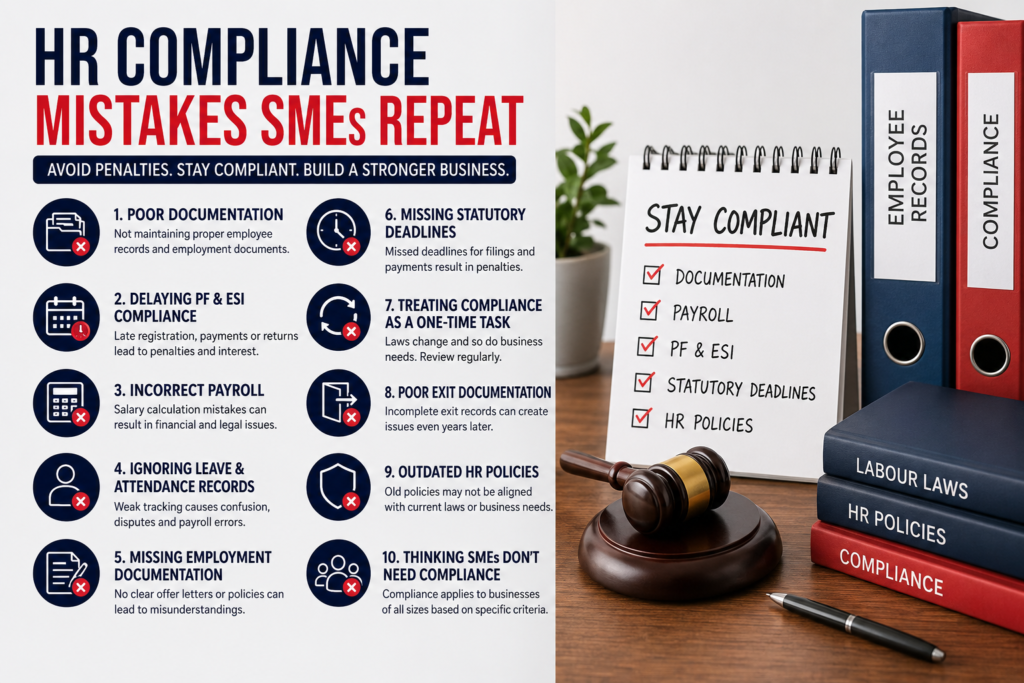
HR Compliance Mistakes SMEs Repeat
For small and medium-sized businesses (SMEs), HR compliance can often feel like a secondary priority. Business owners are usually focused on sales, operations, customers, and growth. However, overlooking basic HR compliance can lead to employee disputes, government notices, financial penalties, and unnecessary legal complications.
The good news is that many HR compliance mistakes are avoidable. Understanding the common errors can help SMEs build better processes and reduce compliance risks.
1. Not Maintaining Proper Employee Records
One of the most common mistakes is failing to maintain complete and updated employee records.
Businesses should properly maintain documents such as:
- Employee identification and contact details
- Appointment or employment letters
- Salary and attendance records
- Leave records
- Bank and payment details
- Statutory registration information
- Resignation and exit documents
Poor documentation can create problems during inspections, audits, or employee disputes.
2. Delaying PF and ESI Compliance
Eligible employees may need to be covered under applicable statutory schemes such as Provident Fund (PF) and Employee State Insurance (ESI).
A common mistake is delaying registration, contribution payments, returns, or employee updates. Such delays can result in additional financial liabilities and compliance issues.
SMEs should maintain a proper monthly compliance calendar to ensure important deadlines are not missed.
3. Incorrect Salary Calculations
Salary processing involves more than simply transferring an employee’s monthly salary.
Businesses need to correctly account for applicable components such as wages, deductions, statutory contributions, leave, bonuses, and other employment-related payments.
Even small payroll errors repeated every month can become significant over time.
4. Ignoring Leave and Attendance Records
Some SMEs rely on informal attendance systems or verbal leave approvals.
This can create confusion about working days, overtime, leave balances, salary calculations, and employee disputes.
A consistent attendance and leave management system helps maintain transparency for both employers and employees.
5. Not Providing Proper Employment Documentation
Hiring an employee without clear employment documentation can create misunderstandings later.
An appointment or employment letter should clearly communicate important terms such as:
- Job role and responsibilities
- Compensation
- Working hours
- Leave provisions
- Notice period
- Applicable company policies
- Other relevant employment conditions
Clear documentation protects both the business and the employee.
6. Missing https://vpassociatess.in/Statutory Deadlines
HR compliance often involves recurring deadlines. Missing them because of poor tracking is a common SME mistake.
Instead of depending on memory, businesses should maintain a compliance calendar containing:
- Due dates
- Responsible person
- Required documents
- Payment details
- Filing status
- Proof of submission
This simple system can significantly reduce last-minute compliance pressure.
7. Treating Compliance as a One-Time Task
HR compliance is not something that can be completed once and forgotten.
Employee strength changes, regulations evolve, business structures change, and new statutory requirements may become applicable.
SMEs should periodically review their HR processes rather than waiting for a notice, inspection, or employee complaint.
8. Poor Employee Exit https://vpassociatess.in/Documentation
Another frequently ignored area is employee separation.
Businesses should properly document resignations, notice periods, final settlements, handovers, and other applicable exit formalities.
Incomplete exit records can create difficulties when questions arise months or years later.
9. Not Updating HR Policies
Some businesses continue using old HR policies even after their workforce, business structure, or applicable legal requirements have changed.
Regular policy reviews can help ensure that internal processes remain relevant and consistent with applicable employment laws.
10. Assuming Small Businesses Don’t Need Compliance
Perhaps the biggest misconception is that HR compliance only matters to large companies.
Being an SME does not automatically eliminate applicable employment or statutory obligations. Requirements can depend on factors such as employee strength, location, industry, wages, and the nature of the establishment.
Businesses should identify which requirements apply to them instead of assuming that compliance is unnecessary.
How SMEs Can Avoid HR Compliance Mistakes
A practical approach is to create a structured HR compliance system.
Businesses should:
- Identify the laws and registrations applicable to their establishment.
- Maintain accurate employee documentation.
- Track PF, ESI, payroll, leave, and other applicable requirements.
- Create a monthly compliance calendar.
- Keep proof of payments and filings safely.
- Review HR policies periodically.
- Conduct internal compliance checks.
- Seek professional guidance when requirements are unclear.
Conclusion
HR compliance mistakes may appear small when they happen individually, but repeated errors can create significant financial and legal risks for an SME.
The best approach is to make compliance a regular part of business operations rather than something addressed only after receiving a notice.
Good HR compliance is not just about avoiding penalties—it helps create organized processes, clearer employee relationships, and a more stable business environment.
Leave a Reply