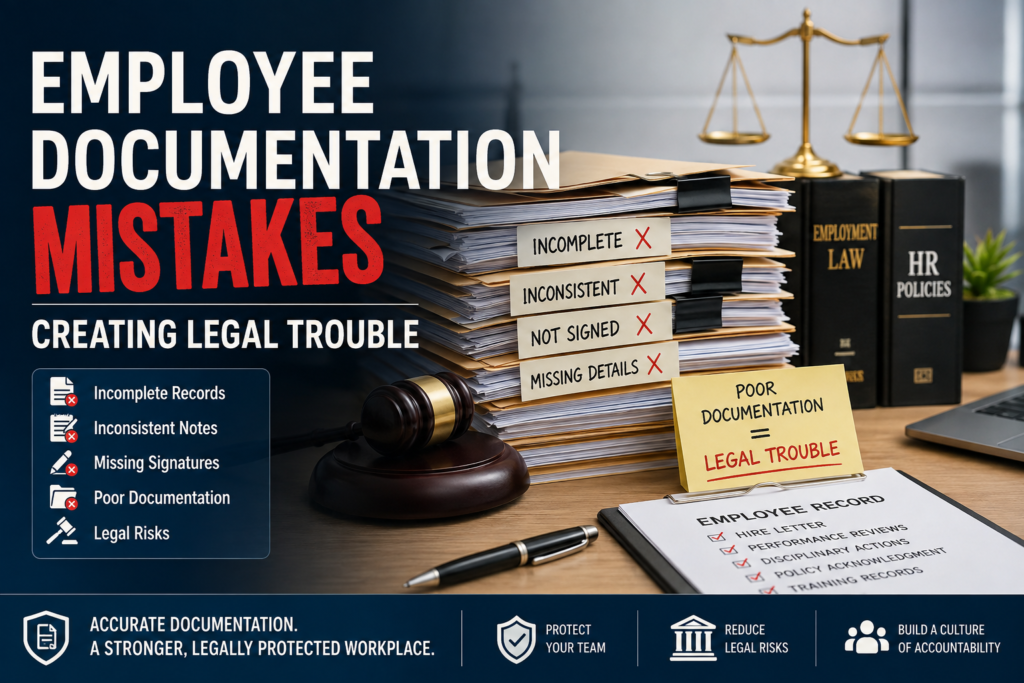
Employee documentation is one of the most critical responsibilities of every HR department. From hiring and performance reviews to disciplinary actions and employee exits, every interaction should be documented accurately. Unfortunately, many organizations overlook proper documentation practices until they face a legal dispute.
Poor or incomplete employee records can weaken an employer’s defense during labor disputes, wrongful termination claims, discrimination allegations, or compliance audits. For HR professionals, understanding common documentation mistakes is essential to protecting both employees and the organization.
This guide explores the most common employee documentation mistakes that create legal trouble and explains how HR teams can avoid them.
Why Ehttps://vpassociatess.in/mployee Documentation Matters
Employee documentation serves as official evidence of workplace decisions and actions. Proper records help organizations:
- Demonstrate fair and consistent treatment of employees
- Support disciplinary decisions
- Maintain compliance with labor laws
- Reduce legal and financial risks
- Improve HR transparency and accountability
- Build trust within the workplace
Without proper documentation, even a justified employment decision can become difficult to defend.
Common Employee Documentation Mistakes
1. Incomplete Employee Records
Missing offer letters, employment contracts, appraisal records, promotion letters, or policy acknowledgments can create confusion during disputes.
Best Practice:
Maintain a complete employee file containing all employment-related documents from hiring to separation.
2. https://vpassociatess.in/Delayed Documentation
Many HR professionals wait days or even weeks before documenting incidents.
This delay often results in:
- Missing facts
- Inconsistent details
- Reduced credibility
Best Practice:
Document incidents immediately while the information is fresh.
3. Subjective or Emotional Language
Documentation should remain factual.
Instead of writing:
“The employee has a terrible attitude.”
Write:
“The employee interrupted the team meeting three times despite being requested to wait.”
Facts are much stronger than opinions during legal proceedings.
4. Lack of Consistency
Treating similar situations differently without documented justification may expose the organization to discrimination claims.
Examples include:
- Different disciplinary actions for identical misconduct
- Unequal attendance enforcement
- Inconsistent performance evaluations
Consistency is one of the strongest legal protections.
5. Missing Ehttps://vpassociatess.in/mployee Acknowledgments
Policies, warnings, performance improvement plans, and disciplinary notices should include employee acknowledgment whenever possible.
If an employee refuses to sign, HR should document the refusal with witness confirmation.
6. Poor Performance Documentation
Many managers mention poor performance verbally but fail to record it.
When termination occurs, there may be no documented history supporting the decision.
Proper performance documentation should include:
- Specific concerns
- Dates
- Measurable expectations
- Improvement plans
- Follow-up meetings
7. Editing Old Records
Changing historical records after an incident can create serious legal complications.
Courts often question altered documents.
Always create updated records instead of modifying previous documentation.
8. Missing Investigation Records
Whenever workplace complaints arise, HR should document:
- Complaint details
- Investigation timeline
- Witness statements
- Evidence reviewed
- Final findings
- Corrective actions
An undocumented investigation may appear incomplete or biased.
9. Ignoring Positive Documentation
Documentation isn’t only for problems.
Maintain records of:
- Awards
- Promotions
- Training
- Certifications
- Recognition
- Positive feedback
Balanced documentation demonstrates fairness and objectivity.
10. Poor Record Retention
Deleting employee files too early can violate legal requirements.
HR departments should maintain records according to applicable labor laws and company retention policies.
Digital HR systems with secure backups can help ensure compliance.
Legal Risks of Poor Documentation
Documentation mistakes may lead to:
- Wrongful termination claims
- Discrimination allegations
- Harassment disputes
- Wage and hour conflicts
- Labor inspections
- Compliance penalties
- Financial settlements
- Reputation damage
Even when employers follow correct procedures, weak documentation can make defending decisions much more difficult.
Best Practices for HR Professionals
To reduce legal risks, HR teams should:
- Maintain standardized documentation formats
- Train managers on proper documentation techniques
- Record incidents promptly
- Focus only on factual information
- Review employee files regularly
- Store records securely
- Ensure confidentiality
- Follow document retention requirements
- Conduct periodic HR compliance audits
How Technology Can Help
Modern HR software simplifies documentation by offering:
- Digital employee records
- Automated reminders
- Secure document storage
- Electronic signatures
- Audit trails
- Role-based access controls
Using technology reduces manual errors while improving compliance and efficiency.
Conclusion
Employee documentation is far more than administrative paperwork—it is a critical safeguard against legal and compliance risks. Accurate, timely, and consistent records help HR professionals make informed decisions, support fair workplace practices, and strengthen the organization’s position if disputes arise.
By avoiding common documentation mistakes and implementing standardized processes, HR teams can protect both employees and the business while fostering a culture of transparency and accountability.
Investing in better documentation today can prevent costly legal complications tomorrow.
Leave a Reply