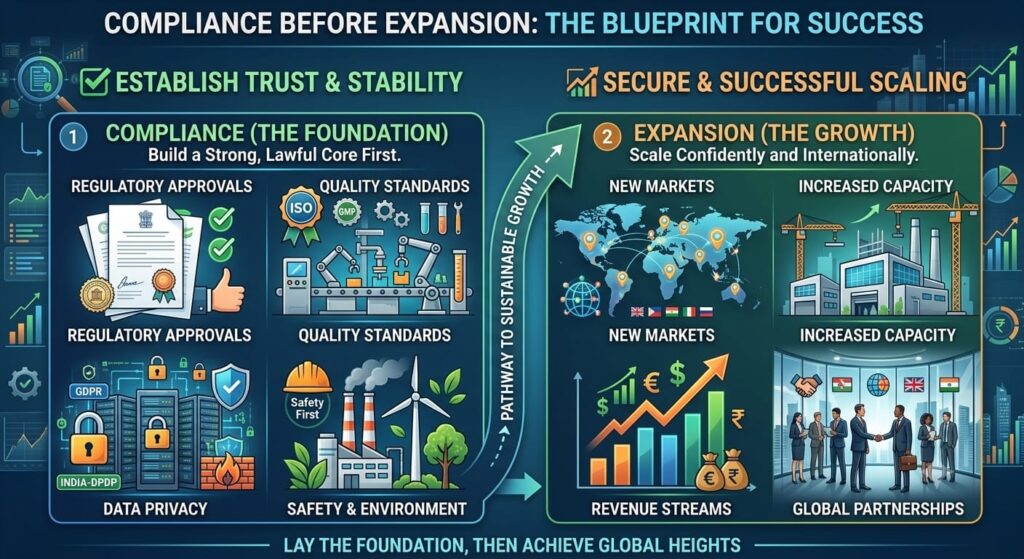
Business expansion is exciting. Opening a new branch, entering a new market, hiring more employees, increasing production, or launching new services can create major opportunities.
But growth also increases compliance responsibilities.
Many businesses focus on sales, investment, infrastructure, and hiring before checking whether their legal and regulatory systems are ready for expansion. This can create problems later—penalties, notices, operational delays, disputes, or unexpected costs.
Why Compliance Matters Before Expansion
When a business is small, certain processes may be manageable informally. As the business grows, however, the number of employees, transactions, vendors, customers, locations, and regulatory obligations can increase significantly.
Expansion may change:
- Tax and registration requirements
- Labour-law obligations
- Licensing requirements
- Employment documentation
- Accounting and reporting responsibilities
- Contractual requirements
- Data and privacy obligations
- Industry-specific regulations
Therefore, compliance should be treated as part of the expansion strategy—not as paperwork to complete afterward.
1. Review Your Existing Registrations
Before entering a new location or business activity, review whether your existing registrations and licences cover the proposed expansion.
Depending on the business and location, this may involve checking registrations related to taxation, shops and establishments, labour laws, local permissions, industry-specific licences, or other regulatory requirements.
An expansion plan should begin with a clear understanding of which registrations are already in place and which may need modification or additional approval.
2. Check Tax Implications
Expansion can significantly affect your tax position.
Opening another location, https://vpassociatess.in/changing the supply chain, entering new markets, or adding new products and services may create additional tax considerations.
Businesses should review their:
- Tax registrations
- GST-related requirements
- Invoicing systems
- Accounting processes
- Tax reporting responsibilities
- Inter-state or cross-border transactions, where applicable
The objective is to ensure that the tax structure supports growth without creating avoidable compliance risks.
3. Strengthen Employee Compliance
Expansion usually means more employees.
With an increasing workforce, businesses need stronger systems for employment documentation, payroll, statutory contributions, leave records, workplace policies, and other applicable labour-law requirements.
Employee compliance should be reviewed before https://vpassociatess.in/recruitment accelerates, rather than after the workforce has already expanded.
4. Review Contracts and Agreements
Business growth often means entering into more agreements with employees, suppliers, distributors, landlords, customers, consultants, and business partners.
Old agreements may not be suitable for the new scale of operations.
Review whether contracts clearly address:
- Responsibilities of each party
- Payment terms
- Confidentiality
- Intellectual property
- Liability
- Termination
- Dispute resolution
- Compliance responsibilities
Well-drafted agreements can reduce misunderstandings and protect the business as operations become more complex.
5. Check Industry-Specific https://vpassociatess.in/Requirements
Not every business faces the same compliance obligations.
Healthcare, manufacturing, finance, food businesses, education, technology, construction, and other sectors may have specific licences, standards, inspections, reporting requirements, or operational rules.
Before expansion, identify the regulations that apply specifically to your industry and proposed activities.
6. Review Internal Documentation
Growth exposes weaknesses in documentation.
Ask whether your business can quickly produce important records when required, such as:
- Licences and registrations
- Tax records
- Employee documents
- Contracts
- Invoices
- Financial records
- Statutory filings
- Policies and approvals
A business that cannot easily locate its compliance records may struggle during an inspection, audit, due diligence process, or regulatory inquiry.
7. Build Compliance Into the Expansion Budget
Compliance costs should not be treated as unexpected expenses.
Expansion planning should consider the cost of registrations, professional advice, licences, systems, audits, employee compliance, documentation, and ongoing reporting.
A small compliance investment before expansion can help prevent much larger costs later.
Compliance Should Grow With the Business
The goal of compliance is not simply to avoid penalties.
A strong compliance framework helps businesses operate with greater confidence, maintain proper records, reduce legal uncertainty, and create a more structured foundation for sustainable growth.
Before expanding your business, ask not only “Can we grow?” but also “Are our compliance systems ready to support that growth?”
Final Thoughts
Expansion should be an opportunity to strengthen the business—not a reason to accumulate new compliance risks.
Review registrations, taxes, employees, contracts, industry requirements, documentation, and internal processes before taking the next major step.
Plan growth. Prepare compliance. Then expand with confidence.
Leave a Reply