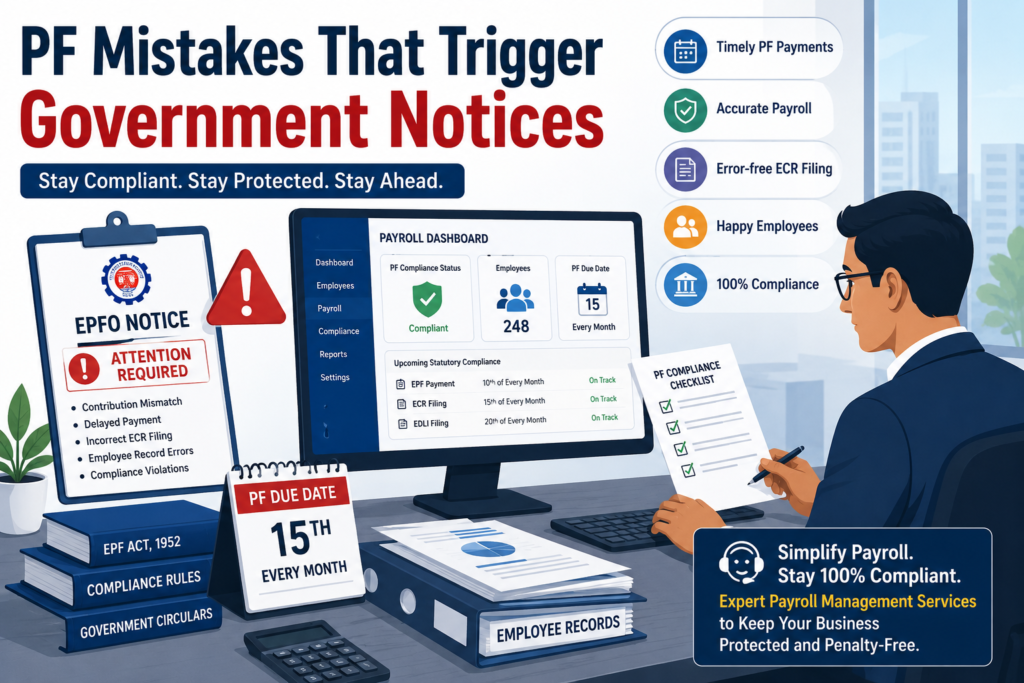
Managing Employee Provident Fund (EPF) compliance is one of the most critical responsibilities for HR and payroll professionals. Even a minor oversight can result in government notices, financial penalties, legal complications, and reputational damage for an organization.
As EPFO continues to strengthen its digital monitoring systems, employers are expected to maintain accurate records, deposit PF contributions on time, and comply with every statutory requirement. Understanding the PF mistakes that trigger government notices can help organizations reduce compliance risks and maintain smooth payroll operations.
This guide explains the most common PF compliance mistakes, their consequences, and practical steps to avoid them.
Why EPF Compliance Matters
EPF is a statutory social shttps://vpassociatess.in/ecurity scheme governed by the Employees’ Provident Funds and Miscellaneous Provisions Act, 1952. Employers must ensure accurate deductions, timely deposits, and correct reporting.
Failure to comply may result in:
- Government notices
- Interest and penalties
- Departmental inspections
- Employee grievances
- Legal proceedings
- Increased compliance audits
Common PF Mistakes That Trigger Government Notices
1. Delayed PF Contribution Deposits
One of the biggest reasons organizations receive EPFO notices is delayed PF deposits.
Late payment attracts:
- Interest under applicable EPF provisions
- Damages and penalties
- Compliance scrutiny
- Increased audit risk
Why this happens
- Payroll processing delays
- Cash flow issues
- Manual payroll errors
- Lack of compliance tracking
2. Incorrect Employee Wage Calculation
Incorrect PF wage calculations often lead to contribution mismatches.
Common errors include:
- Excluding eligible salary https://vpassociatess.in/components
- Wrong basic wage calculations
- Incorrect treatment of allowances
- Misclassification of earnings
These discrepancies are easily identified through EPFO records.
3. Incorrect UAN Details
A wrong Universal Account Number (UAN) creates several compliance issues.
Examples include:
- Duplicate UANs
- Incorrect Aadhaar linkage
- Wrong employee details
- PAN mismatch
- Name inconsistencies
These errors delay claim processing and increase the likelihood of government verification.
4. Missing Employee Registration
Every eligible employee must be enrolled under EPF.
Common registration mistakes include:
- Delayed onboarding
- Missing employee records
- Incorrect joining dates
- Failure to generate UAN
These issues frequently attract compliance notices during inspections.
5. Filing Incorrect Electronic Challan-cum-Return (ECR)
The Electronic Challan-cum-Return (ECR) is a critical monthly filing.
Mistakes include:
- Wrong contribution amounts
- Missing employees
- Duplicate entries
- Incorrect exit dates
- Invalid UAN mapping
Even small filing errors may trigger automated EPFO alerts.
6. Failure to Update Employee Exit Details
Many employers forget to update employee exits promptly.
Consequences include:
- Incorrect active employee count
- Contribution mismatches
- Claim delays
- Compliance notices
Timely updating exit information is essential for accurate EPF records.
7. Poor Payroll Documentation
Incomplete payroll records make it difficult to respond to departmental inspections.
Maintain records such as:
- Salary registers
- Attendance records
- Appointment letters
- Wage revisions
- PF payment receipts
- ECR acknowledgments
Proper documentation strengthens compliance during audits.
8. Ignoring EPFO Circulars and Regulatory Updates
EPFO regularly introduces procedural changes and compliance updates.
Organizations relying on outdated payroll practices often receive notices because they fail to implement new requirements.
HR teams should regularly monitor regulatory updates and revise payroll processes accordingly.
Warning Signs Your Organization May Receive an EPFO Notice
Watch for these indicators:
- Frequent payroll corrections
- Late PF remittances
- Employee complaints
- Contribution mhttps://vpassociatess.in/ismatches
- Repeated ECR errors
- Unreconciled payroll records
- Incomplete employee KYC
Addressing these issues proactively reduces compliance risks.
Best Practices to https://vpassociatess.in/Prevent Government Notices
HR and payroll professionals can significantly reduce compliance risks by following these practices:
- Automate payroll processing.
- Conduct monthly PF reconciliation.
- Verify employee KYC before onboarding.
- Submit PF contributions before deadlines.
- Review ECR data before filing.
- Maintain complete payroll documentation.
- Perform regular internal compliance audits.
- Stay updated with EPFO notifications.
- Train payroll staff on statutory compliance.
- Partner with experienced payroll professionals.
How Payroll Management Services Help
Modern payroll management services simplify EPF compliance through automation and expert oversight.
Key benefits include:
- Automated PF calculations
- Timely statutory filings
- Error-free ECR submissions
- Compliance monitoring
- Employee record management
- Audit-ready documentation
- Reduced manual intervention
- Lower compliance risk
For growing organizations, outsourcing payroll management can significantly reduce the chances of receiving government notices while improving operational efficiency.
Conclusion
Government notices related to EPF compliance are often preventable. Most notices arise from delayed deposits, inaccurate payroll calculations, incorrect employee records, filing mistakes, or poor documentation.
By implementing strong payroll controls, conducting regular compliance reviews, and leveraging professional payroll management services, HR teams can ensure statutory compliance and protect their organizations from costly penalties.
If your organization wants to eliminate payroll compliance risks and ensure accurate EPF management, investing in expert payroll management services is a proactive step toward long-term compliance.
Leave a Reply