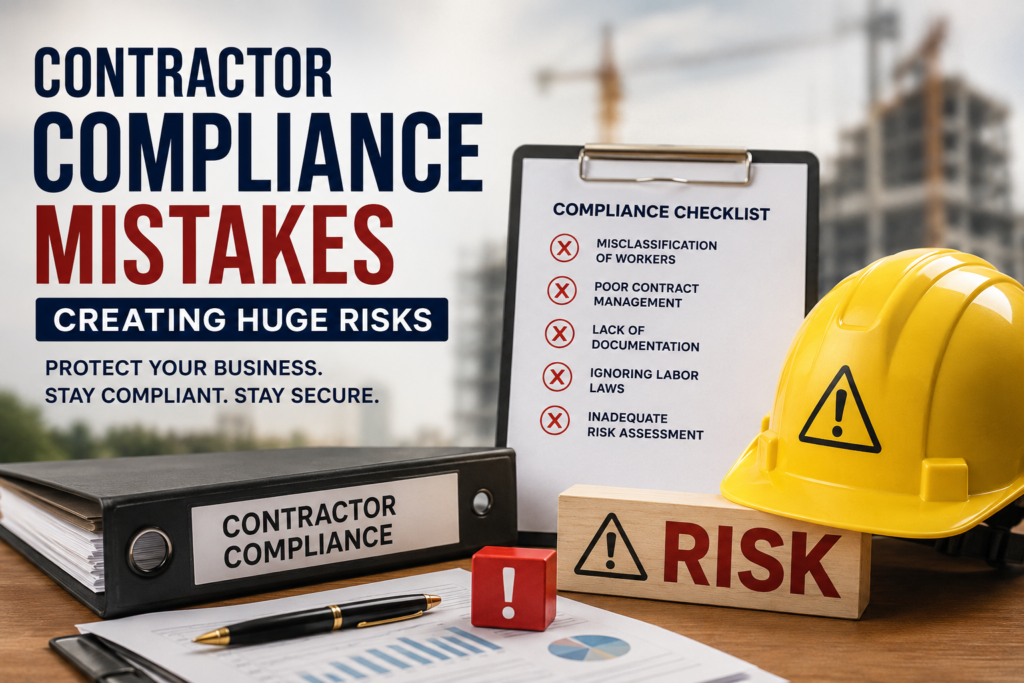
In today’s fast-moving business environment, organizations increasingly rely on contractors, freelancers, and third-party vendors to access specialized skills, reduce costs, and improve operational flexibility. While this approach offers significant advantages, it also introduces substantial compliance risks that many businesses underestimate.
A single contractor compliance mistake can result in financial penalties, legal disputes, reputational damage, tax liabilities, and even regulatory investigations. Unfortunately, many organizations only recognize these risks after facing costly consequences.
This article explores the most common contractor compliance mistakes and provides practical guidance to help businesses reduce risk while maintaining an efficient contractor workforce.
Why Contractor Compliance Matters
Contractor compliance is more than simply collecting invoices or signing agreements. It involves ensuring that every contractor relationship complies with employment laws, tax regulations, industry standards, insurance requirements, and contractual obligations.
As governments worldwide increase scrutiny of worker classification and labor practices, businesses must adopt proactive compliance strategies rather than reactive fixes.
Failure to do so can expose organizations to significant legal and financial risks.
1. Misclassifying Employees as Independent Contractors
One of the most common—and expensive—compliance mistakes is worker misclassification.
Many companies classify workers as independent contractors when they legally meet the criteria of employees. Regulators evaluate several factors, including:
- Degree of control over the worker
- Working hours
- Method of payment
- Use of company equipment
- Exclusivity of the relationship
- Integration into business operations
If authorities determine that a contractor should have been treated as an employee, businesses may face:
- Back taxes
- Unpaid benefits
- Overtime claims
- Social security contributions
- Employment law penalties
- Interest and fines
Misclassification audits are becoming increasingly common across many industries.
2. Inadequate Contractor Agreements
Many businesses rely on outdated or generic contract templates.
A contractor agreement should clearly define:
- Scope of work
- Payment terms
- Deliverables
- Confidentiality obligations
- Intellectual property ownership
- Data protection requirements
- Termination conditions
- Compliance expectations
Poorly written contracts create ambiguity that often leads to disputes and legal complications.
3. Ignoring Local Labor Laws
Organizations working with contractors across multiple states or countries often assume the same rules apply everywhere.
In reality, labor regulations vary significantly by jurisdiction.
Different regions may have unique requirements regarding:
- Worker classification
- Tax withholding
- Mandatory registrations
- Benefits eligibility
- Recordkeeping
- Working time regulations
Ignoring local laws can result in severe compliance violations and costly penalties.
4. Poor Documentation Practices
Documentation is a critical component of contractor compliance.
Many businesses fail to maintain:
- Signed contracts
- Tax forms
- Identity verification
- Insurance certificates
- Business registrations
- Payment records
- Compliance certifications
Without proper documentation, organizations may struggle to demonstrate compliance during audits or legal proceedings.
A centralized document management system can significantly reduce this risk.
5. Weak Vendor Due Diligence
Before engaging contractors, businesses should verify their legitimacy.
Due diligence should include:
- Business registration verification
- Tax identification validation
- Insurance coverage
- Professional licenses
- Financial stability
- Regulatory history
- Industry certifications
Skipping these checks increases exposure to fraud, non-compliance, and operational disruptions.
6. Lack of Data Security Conhttps://vpassociatess.in/trols
Contractors often receive access to confidential company information, customer data, and internal systems.
Without proper controls, organizations become vulnerable to:
- Data breaches
- Intellectual property theft
- Privacy violations
- Cybersecurity incidents
Best practices include:
- Role-based system access
- Non-disclosure agreements (NDAs)
- Multi-factor authentication
- Regular access reviews
- Secure file-sharing platforms
Data protection should be integrated into every contractor engagement.
7. Failing to Monitor Contractor Performance
Compliance doesn’t end once a contract is signed.
Businesses should continuously mohttps://vpassociatess.in/nitor contractors to ensure ongoing compliance with:
- Contractual obligations
- Quality standards
- Regulatory requirements
- Safety protocols
- Ethical guidelines
Regular reviews help identify issues before they escalate into larger risks.
8. Overlooking Insurance Requirements
Many organizations assume contractors carry adequate insurance—but never verify it.
Depending on the industry, contractors may require:
- General liability insurance
- Professional indemnity insurance
- Workers’ compensation coverage
- Cyber liability insurance
- Commercial auto insurance
Maintaining current insurance certificates helps reduce financial exposure if an incident occurs.
9. Inconsistent Onboarding and Offboarding
Contractor onboarding often receives little attention compared to employee onboarding.
An effective onboarding process should include:
- Identity verification
- Compliance documentation
- Security training
- Policy acknowledgments
- System access controls
Similarly, offboarding should ensure:
- System access is revoked
- Company assets are returned
- Confidential information remains protected
- Final documentation is completed
Neglecting these processes creates unnecessary operational and security risks.
10. Treating Cohttps://vpassociatess.in/mpliance as a One-Time Activity
Regulations evolve continuously.
Businesses that review contractor compliance only once may unknowingly fall out of compliance over time.
Organizations should conduct periodic reviews that include:
- Contract updates
- Regulatory changes
- Risk assessments
- Documentation audits
- Policy reviews
- Internal compliance training
Continuous improvement is essential for maintaining a compliant contractor management program.
Best Practices to Reduce Contractor Compliance Risks
To strengthen contractor cohttps://vpassociatess.in/mpliance, organizations should:
- Develop standardized contractor onboarding procedures.
- Use legally reviewed contractor agreements.
- Verify worker classification before engagement.
- Maintain complete compliance documentation.
- Conduct regular compliance audits.
- Monitor regulatory changes across operating regions.
- Limit contractor access to sensitive systems.
- Review insurance and licensing periodically.
- Implement contractor management software where appropriate.
- Train managers on contractor compliance responsibilities.
A proactive approach can significantly reduce legal, financial, and operational risks.
Final Thoughts
Contractors play a vital role in helping businhttps://vpassociatess.in/esses remain agile and competitive. However, without proper compliance controls, contractor relationships can quickly become a source of costly legal and financial exposure.
By addressing common mistakes such as worker misclassification, poor documentation, inadequate contracts, weak security practices, and inconsistent oversight, organizations can protect themselves while building stronger, more compliant contractor partnerships.
Leave a Reply