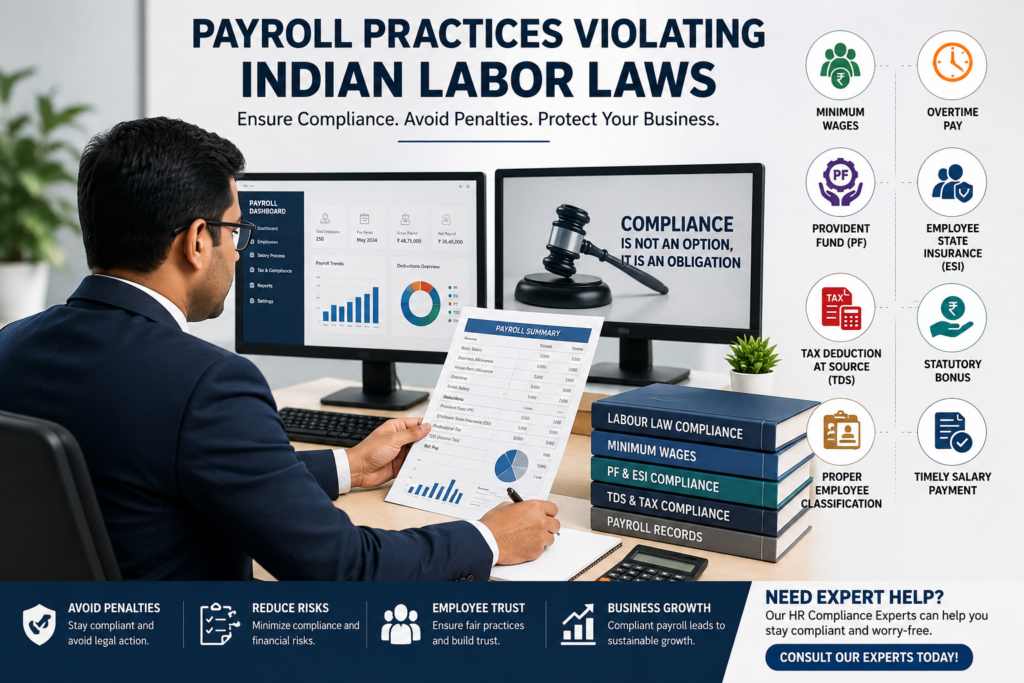
Payroll compliance is one of the most critical responsibilities of every organization in India. Even a small payroll error can result in statutory penalties, employee disputes, legal notices, and reputational damage. Understanding Payroll Practices Violating Indian Labor Laws is essential for payroll managers who want to maintain compliance while protecting their organization from financial and legal risks.
As Indian labour regulations continue to evolve through the Labour Codes and existing employment laws, organizations must ensure that payroll processes remain accurate, transparent, and legally compliant. This guide explains the most common payroll compliance violations, the applicable legal provisions, potential penalties, and practical steps to avoid them.
Why Payroll Compliance Matters Under Indian Labour Laws
Payroll is much more than salary processing. It includes statutory deductions, minimum wage compliance, overtime calculations, leave encashment, bonus payments, provident fund contributions, employee state insurance, professional tax, tax deductions at source, and maintenance of statutory records.
Failure to comply with these obligations may expose employers to inspections, penalties, employee claims, and litigation.
Common Payroll Practices Violating Indian Labor Laws
Below are the payroll mistakes most frequently identified during labour inspections and compliance audits.
Paying Less Than the Minimum Wage
One of the most serious Payroll Practices Violating Indian Labor Laws is paying employees below the applicable minimum wage notified by the Central or State Government.
Employers must:
- Track revised minimum wage notifications.
- Differentiate between skilled, semi-skilled, and unskilled workers.
- Consider state-specific wage rates.
- Include applicable wage components.
Failure to comply may result in recovery proceedings, penalties, and prosecution under applicable labour laws.
Incorrect Overtime Calculation
Employees eligible for overtime must receive compensation according to applicable labour laws.
Common violations include:
- Ignoring overtime hours.
- Paying regular hourly wages instead of overtime rates.
- Manipulating attendance records.
- Excluding eligible employees.
Payroll managers should maintain accurate attendance records and ensure overtime calculations comply with statutory provisions.
Delayed Salary Payments
Late salary payments are another major payroll compliance issue.
Delays can:
- Violate wage payment laws.
- Trigger employee grievances.
- Attract labour department scrutiny.
- Affect employee morale.
Organizations should establish automated payroll calendars to ensure timely salary disbursement.
Failure to Deposit Provident Fund Contributions
Provident Fund compliance is mandatory for eligible establishments.
Common mistakes include:
- Delayed PF deposits.
- Incorrect wage calculations.
- Non-registration of eligible employees.
- Incorrect UAN mapping.
Interest and damages may be imposed for delayed remittances.
Non-Compliance with Employee State Insurance (ESI)
Eligible employees must receive ESI benefits where applicable.
Payroll violations include:
- Incorrect employee eligibility assessment.
- Late contribution deposits.
- Incorrect wage reporting.
- Failure to register eligible employees.
These errors can result in inspections and financial liabilities.
Wrong Tax Deduction at Source (TDS)
Payroll teams must accurately calculate employee income tax deductions.
Common mistakes include:
- Incorrect tax regime selection.
- Ignoring employee declarations.
- Wrong investment calculations.
- Delayed TDS deposits.
- Incorrect Form 16 issuance.
Proper payroll software and periodic tax reviews help reduce these risks.
Misclassification of Employees
Treating employees as consultants or conhttps://vpassociatess.in/tractual workers solely to avoid statutory obligations is a significant compliance risk.
Improper classification may lead to:
- PF liabilities.
- ESI liabilities.
- Bonus claims.
- Gratuity disputes.
- Labour litigation.
Payroll managers should ensure employment classifications reflect actual working relationships.
Failure to Pay Statutory Bonus
Eligible employees covered under the Payment of Bonus Act must receive statutory bonus where applicable.
Payroll violations include:
- Non-payment.
- Incorrect bonus calculations.
- Delayed bonus payments.
- Wrong eligibility assessment.
Regular compliance audits help ensure adherence.
Incorrect Leave Encashment Calculations
Many organizations calculate leave encashment incorrectly or ignore statutory leave provisions.
Payroll managers should:
- Maintain updated leave records.
- Follow company policies aligned with labour laws.
- Calculate leave encashment accurately.
- Ensure proper final settlement calculations.
Errors in Full and Final Settlement
Employee separation requires timely and accurate settlement of:
- Pending salary
- Leave encashment
- Bonus
- Gratuity
- Incentives
- Statutory deductions
Delayed or inaccurate settlements frequently lead to employee complaints and legal disputes.
What Are the Legal https://vpassociatess.in/Consequences of Payroll Non-Compliance?
Organizations engaging in Payroll Practices Violating Indian Labor Laws may face:
- Monetary penalties
- Interest on delayed statutory payments
- Labour department inspections
- Employee compensation claims
- Litigation costs
- Criminal prosecution in certain cases
- Damage to employer reputation
The severity of consequences depends on the applicable statute, the nature of the violation, and whether the default is repeated or willful.
;
How Payroll Managers Labour Law Compliance
Conduct Regular Payroll Audits
Quarterly payroll audits help identify compliance gaps before they become legal issues.
Monitor Labour Law Updates
Payroll managers should regularly track amendments relating to:
- Minimum wages
- Provident Fund
- Employee State Insurance
- Professional Tax
- Income Tax
- Labour Codes
- State-specific labour regulations
Use Reliable Payroll Software
Automated payroll systems reduce manual errors and improve statutory compliance through timely calculations and reporting.
Maintain Complete Payroll Documentation
Maintain records including:
- Attendance registers
- Wage registers
- Salary slips
- PF and ESI challans
- TDS records
- Employee declarations
- Leave records
Proper documentation is essential during labour inspections.
Seek Professional HR Compliance Consulting
As labour laws continue to evolve, partnering with experienced HR compliance consultants helps organizations:
- Conduct payroll compliance audits.
- Ensure statutory adherence.
- Minimize legal risks.
- Stay updated with regulatory changes.
- Build robust payroll governance processes.
Frequently Asked Questions
http://Learn the most common payroll practices violating Indian labohttps://vpassociatess.in/What are Payroll Practices Violating Indian Labor Laws?
These include paying below minimum wages, delaying salary payments, incorrect overtime calculations, PF and ESI non-compliance, tax deduction errors, employee misclassification, and inaccurate statutory payments.
Can payroll mistakes lead to legal action?
Yes. Depending on the nature of the violation, employers may face penalties, inspections, employee claims, interest on delayed payments, and prosecution under applicable laws.
How often should payroll compliance audits be conducted?
Organizations should conduct payroll compliance audits at least once every quarter, with additional reviews whenever significant labour law amendments are introduced.
Which labour laws affect payroll in India?
Payroll compliance is influenced by laws relating to wages, provident fund, employee state insurance, bonus, gratuity, income tax, maternity benefits, shops and establishments, and the Labour Codes, along with applicable state regulations.
Why should companies hire HR compliance consultants?
HR compliance consultants help organizations identify payroll risks, maintain statutory compliance, prepare for labour inspections, and reduce exposure to legal penalties.
Conclusion
Understanding Payroll Practices Violating Indian Labor Laws is essential for payroll managers responsible for ensuring accurate salary processing and statutory compliance. Regular audits, updated payroll systems, timely statutory payments, and continuous monitoring of labour law developments significantly reduce compliance risks. Organizations that invest in proactive payroll governance and professional HR compliance consulting not only avoid penalties but also strengthen employee trust and operational efficiency.
Leave a Reply