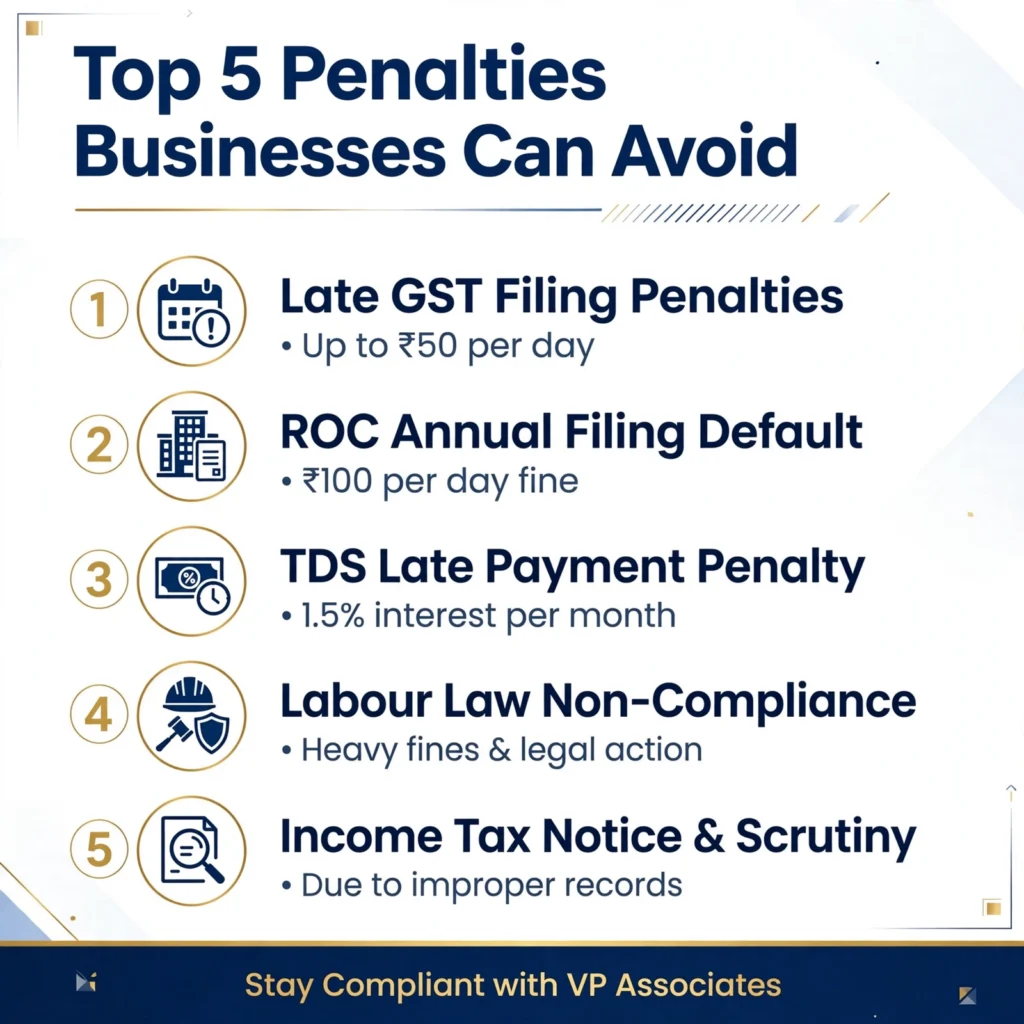
Top 5 Penalties Businesses Can Avoid With Better Compliance
Running a business is not just about increasing sales, managing employees, and serving customers. It also involves staying compliant with tax, accounting, labour, and statutory requirements.
Many businesses face penalties not because they intentionally break the law, but because of missed deadlines, incorrect filings, incomplete records, or poor compliance tracking.
The good news? Most of these penalties can be reduced or avoided with proper planning and timely compliance.
Here are the Top 5 penalties businesses should watch out for.
1. GST Late Filing & Payment Penalties
GST compliance is one of the most important recurring responsibilities for registered businesses.
Delaying GST returns can result in late fees and interest, depending on the type of return and circumstances. For example, the GST portal calculates applicable interest and late fees when filing delayed GSTR-3B returns. (GST Tutorial)
How businesses can avoid it:
- Maintain a monthly GST compliance calendar.
- Reconcile sales and purchase data regularly.
- Check invoices before filing returns.
- Track GST payment and filing due dates.
- Avoid waiting until the last day to file.
Small delays can become recurring costs, especially when compliance is handled casually.
2. TDS Late Filing & Incorrect Return Penalties
Businesses making certain payments such as salaries, professional fees, rent, or contractor payments may have TDS obligations.
Failure to file TDS statements on time can attract a late filing fee of ₹200 per day, subject to the prescribed limit. In certain cases, additional penalties under Section 271H may also apply. (Etds)
Incorrect TDS statements can create additional compliance problems.
How businesses can avoid it:
- Deduct TDS correctly.
- Deposit TDS within the applicable deadline.
- Reconcile TDS records before filing.
- Verify PAN and payment details.
- File quarterly TDS returns on time.
A proper TDS checklist can prevent both unnecessary expenses and follow-up notices.
3. Income Tax https://vpassociatess.in/Filing & Compliance Penalties
Income tax compliance involves more than simply filing an annual return.
Businesses need to maintain proper books, calculate taxes correctly, pay applicable taxes, and meet reporting requirements. The Income Tax Department provides specific penalty provisions for various defaults. (Etds)
Late filing can also result in applicable late filing fees and interest.
How businesses can avoid it:
- Keep books updated throughout the year.
- Reconcile bank and accounting records.
- Review tax payments in advance.
- Maintain supporting documents for expenses.
- Start tax preparation well before the deadline.
Tax planning should happen throughout the year—not only when the return filing deadline approaches.
4. Penalties Due to https://vpassociatess.in/Incorrect or Incomplete Information
Sometimes a business files a return on time but still faces compliance problems because the information is incorrect.
Common examples include:
- Incorrect turnover figures
- Wrong tax calculations
- Mismatched invoices
- Incorrect TDS information
- Incomplete statutory records
- Incorrect declarations
Compliance is not simply about filing on time. The information being submitted must also be accurate.
How businesses can avoid it:
Create a review process where important returns and documents are checked before submission.
A simple prepare → review → reconcile → file system can significantly reduce avoidable mistakes.
5. Penalties From Missing Statutory & Labour Compliance
Businesses with employees may have additional obligations relating to payroll, employee records, labour laws, PF/ESI where applicable, and other statutory requirements.
Missing documentation or deadlines can create unnecessary notices, interest, penalties, and administrative work.
How businesses can avoid it:
- Maintain proper employee documentation.
- Track applicable PF/ESI and payroll compliances.
- Maintain attendance and salary records.
- Keep statutory registers and records updated where required.
- Review compliance requirements whenever the business expands or changes its workforce.
Good documentation is one of the simplest ways to demonstrate that your business is following the required processes.
How Can Businesses Reduce Compliance Risk?
Instead of managing compliance only when a deadline arrives, businesses should create a monthly compliance system.
A simple system can include:
1. Compliance Calendar
List every applicable GST, TDS, income tax, payroll and statutory deadline.
2. Document Checklist
Keep invoices, payment records, employee documents and accounting records organized.
3. Monthly Reconciliation
Compare accounting records with bank, GST and TDS data.
4. Review Before Filing
Check important figures and supporting documents before submission.
5. Professional Compliance Review
Periodic professional review can help identify gaps before they become expensive problems.
Final Thoughts
Penalties can quickly turn into an unnecessary business expense. More importantly, repeated compliance mistakes can consume management time and create avoidable stress.
The best strategy is simple: don’t wait for a notice to discover a compliance problem.
Build a system that tracks deadlines, maintains accurate records, reviews filings, and addresses compliance requirements proactively.
Better compliance today can mean fewer penalties, fewer notices, and greater peace of mind tomorrow.
Note: Penalty and fee provisions can vary depending on the applicable law, taxpayer category, period, and nature of the default. Businesses should verify the provisions applicable to their specific circumstances before taking action.
Leave a Reply