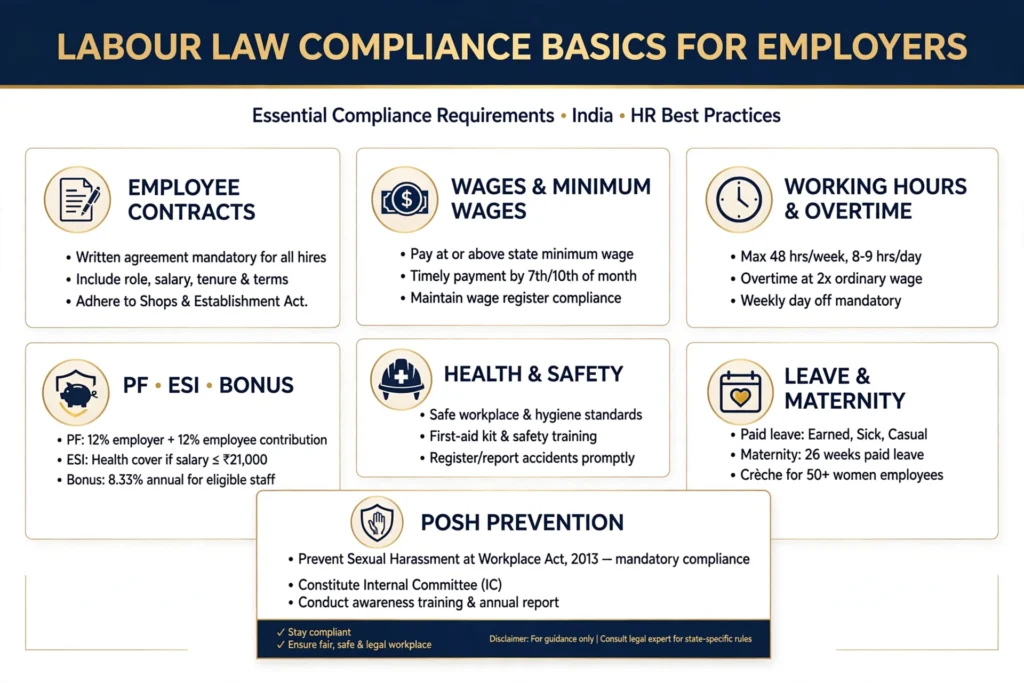
Running a business is not only about managing sales, employees, and finances. Employers also have a responsibility to follow applicable labour laws and provide employees with a fair, safe, and legally compliant workplace. Labour law compliance helps businesses avoid unnecessary legal issues while creating a more organized working environment.
For small businesses, startups, factories, offices, and growing companies, understanding the basics of labour law compliance is important from the beginning.
What Is Labour Law Compliance?
Labour law compliance means following the applicable laws, rules, notifications, and employment-related requirements governing the relationship between employers and employees.
Depending on the nature, size, location, and workforce of a business, different registrations, records, benefits, workplace standards, and reporting requirements may apply.
Some common areas include:
- Employee wages and salary-related requirements
- Working hours and leave
- Employee records and registers
- Social security benefits
- Workplace safety
- Maternity-related benefits
- Prevention of workplace harassment
- Appointment and employment documentation
- Termination and service conditions
The exact requirements can vary depending on the establishment and applicable central or state legislation.
Why Is Labour Law Compliance Important?
Labour compliance is not simply a paperwork exercise. It can affect the overall functioning and reputation of a business.
1. Helps Avoid Legal Problems
Failure to comply with applicable labour requirements can result in notices, penalties, inspections, disputes, or other legal consequences. Maintaining proper compliance can reduce these risks.
2. Creates Better Employee Relations
Employees are more likely to feel secure when their wages, leave, benefits, working conditions, and other employment-related matters are properly managed.
3. Keeps Business Records Organized
Proper maintenance of employee information, wage records, attendance, leave records, and other documents makes it easier to manage the workforce and respond to official requirements.
4. Supports Business Growth
As a business expands and hires more employees, its compliance responsibilities may also increase. Establishing proper systems early can make future expansion easier to manage.
Key Labour Law Compliance Areas for Employers
1. Employee Appointment and Documentation
Employers should maintain appropriate employment documentation. Depending on the business and applicable requirements, this may include appointment letters, employee details, wage information, attendance records, leave records, and other employment-related documents.
Clear documentation can also help prevent misunderstandings between employers and employees.
2. Wages and Salary Compliance
Employers need to ensure that employees are paid according to applicable wage requirements and within the prescribed timelines.
Salary records should be maintained properly, including information relating to deductions and other applicable components.
3. Working Hours and Leave
Applicable rules may prescribe requirements relating to working hours, weekly holidays, overtime, leave, and other conditions of employment.
Employers should understand the rules applicable to their particular establishment and maintain appropriate attendance and leave records.
4. Provident Fund and Social Security
Depending on eligibility and applicability, businesses may have obligations relating to social security schemes such as Employees’ Provident Fund (EPF) and Employees’ State Insurance (ESI).
Employers should determine whether their establishment and employees fall within the applicable requirements and complete the necessary registrations and contributions.
5. Workplace Safety
Employers have responsibilities regarding workplace health and safety, particularly in establishments where employees may face occupational risks.
Factories and certain other workplaces may have additional safety, welfare, documentation, and inspection requirements.
6. Maternity Benefits
Eligible employees may be entitled to maternity-related benefits under applicable law. Employers should understand the relevant provisions and ensure that eligible employees receive the benefits applicable to them.
7. Prevention of Sexual Harassment at Workplace
Organizations covered by the applicable workplace sexual-harassment law need to follow the required procedures and establish an appropriate Internal Committee (IC/ICC) where applicable.
Businesses should also create awareness among employees and maintain the required documentation and processes.
8. Registers and Records
Labour compliance often involves maintaining records relating to employees, wages, attendance, leave, working hours, benefits, and other employment matters.
Keeping these records updated can make compliance management significantly easier.
Labour Compliance for Small Businesses
Small businesses sometimes assume that labour laws are relevant only to large companies. This can create compliance gaps.
Even a small business may have specific https://vpassociatess.in/obligations depending on its employee count, industry, location, and type of establishment.
Therefore, employers should not rely only on the size of their business. Instead, they should identify which laws and registrations actually apply to their establishment.
Common Labour Compliance Mistakes
Some common mistakes employers should avoid include:
- Not providing proper employment documentation
- Delaying salary payments
- Ignoring applicable minimum wage requirements
- Failing to maintain employee records
- Missing statutory contributions or filings
- Not maintaining attendance and leave records
- Ignoring workplace safety requirements
- Not implementing required POSH procedures
- Assuming that the same compliance requirements apply to every business
- Waiting for a government notice before reviewing compliance
How Employers Can https://vpassociatess.in/Maintain Better Compliance
A practical labour compliance system can include:
Step 1: Identify the nature and location of the business.
Step 2: Determine the number and category of employees.
Step 3: Identify applicable labour laws, registrations, and licences.
Step 4: Maintain employee and wage-related records properly.
Step 5: Track statutory payments, returns, and deadlines.
Step 6: Review workplace policies and employee documentation regularly.
Step 7: Conduct periodic compliance reviews to identify gaps.
Professional guidance can also be useful when a business is unsure about which labour laws apply to its specific operations.
Conclusion
Labour law compliance is an essential part of responsible business management. It helps employers understand their legal responsibilities, maintain proper employee records, manage statutory requirements, and reduce the risk of avoidable disputes and penalties.
Instead of treating compliance as a one-time activity, employers should make it a regular part of their business operations. As the workforce and business expand, compliance requirements should also be reviewed and updated accordingly.
A compliant workplace is built through proper documentation, timely statutory actions, regular reviews, and awareness of the laws applicable to the business.
Leave a Reply