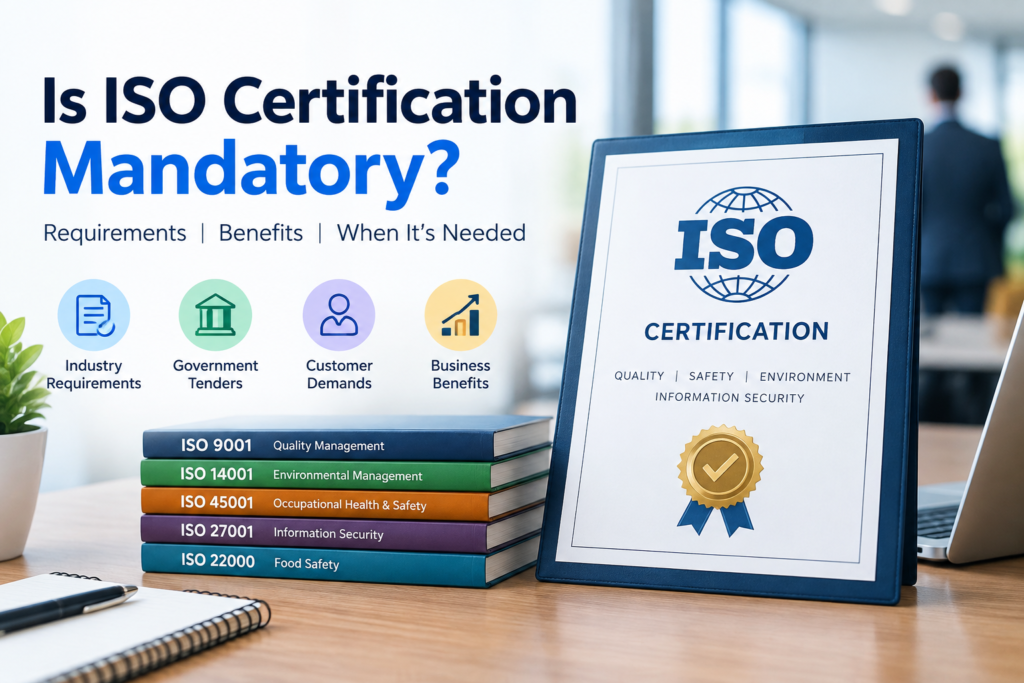
Many business owners hear about ISO certification and wonder: “Is ISO certification mandatory for my business?” The simple answer is not always.
ISO certification is generally voluntary for most businesses. However, in certain industries, government tenders, contracts, or specific regulatory requirements, having particular certifications may be required or may become an important condition for doing business.
What Is ISO Certification?
ISO certification is a formal recognition that a business follows the requirements of a particular ISO management system standard.
For example:
- ISO 9001 – Quality Management System
- ISO 14001 – Environmental Management System
- ISO 45001 – Occupational Health & Safety Management System
- ISO 27001 – Information Security Management System
- ISO 22000 – Food Safety Management System
The appropriate standard depends on the nature and requirements of the business.
Is ISO Certification Mandatory for Every Business?
No. ISO certification is not automatically mandatory for every business.
A small business, startup, manufacturer, service provider, or professional firm may operate legally without ISO certification unless a specific law, contract, tender, customer requirement, or industry condition requires it.
However, businesses may still choose to obtain ISO certification to demonstrate that they follow structured processes and quality or management practices.
When Can ISO Certification Become Necessary?
Although ISO certification is usually voluntary, it can become important in certain situations.
1. Government Tenders
Some government tenders may specify ISO certification as an eligibility or qualification requirement. If a business wants to participate in such a tender, it may need to meet the stated certification requirements.
2. Customer Requirements
Large companies or international clients may require suppliers and service providers to have specific certifications before entering into a business relationship.
3. Industry-Specific Requirements
Certain industries may have additional regulatory, contractual, or quality requirements. Businesses should check the rules applicable to their particular sector rather than assuming that one ISO standard applies to everyone.
4. Improving Business Processes
Even when certification is not legally required, implementing an ISO management system can help a business establish documented processes, responsibilities, quality controls, and continual improvement practices.
Is ISO 9001 Mandatory?
ISO 9001 certification is not generally mandatory for every business.
ISO 9001 focuses on quality management and helps organizations establish consistent processes for delivering products or services and improving customer satisfaction.
A business may choose ISO 9001 certification because of customer expectations, tender requirements, supply-chain requirements, or its own quality-management goals.
What Are the Benefits of ISO Certification?
Even when it is not mandatory, ISO certification can offer several potential business benefits:
- Better-defined business processes
- Improved documentation and process control
- Greater consistency in products or services
- Increased customer confidence
- Support for supplier and client requirements
- Better preparation for certain tenders
- A structured approach to identifying and managing risks
- Continual improvement of business operations
However, certification itself does not automatically guarantee that a business provides better products or services. Its value depends on how effectively the management system is implemented and maintained.
Do Startups and Small Businesses Need ISO Certification?
Not every startup or small business needs ISO certification.
The decision should depend on factors such as:
- Business activity
- Industry requirements
- Customer expectations
- Government tender conditions
- Supply-chain requirements
- Future expansion plans
- Internal quality and process-management goals
A small business should first identify whether certification is actually required or whether it would provide a practical business advantage.
ISO Certification vs. ISO Compliance
These terms are sometimes used interchangeably, but they are not exactly the same.
ISO certification generally involves an independent certification body assessing an organization’s management system against a particular ISO standard and issuing certification when the requirements are met.
ISO compliance can refer more broadly to following the applicable requirements of an ISO standard or using its framework, whether or not the organization has obtained formal certification.
How Can a Business Get ISO Certified?
A typical certification process may involve:
- Selecting the appropriate ISO standard.
- Understanding the standard’s requirements.
- Establishing and documenting relevant processes.
- Implementing the management system.
- Conducting internal reviews or audits.
- Addressing identified issues.
- Undergoing an external certification audit.
- Receiving certification if the requirements are successfully met.
- Maintaining the system through ongoing monitoring and improvement.
The exact process can vary depending on the standard, organization, and certification arrangement.
Final Thoughts
ISO certification is not mandatory for every business. Whether your business needs it depends on applicable laws, industry requirements, contracts, customer expectations, and tender conditions.
Before applying for certification, businesses should determine which ISO standard is relevant and whether certification is actually required for their specific activity.
If you are unsure whether your business needs ISO certification, professional guidance can help you understand the applicable requirements and choose an appropriate certification approach.
Leave a Reply