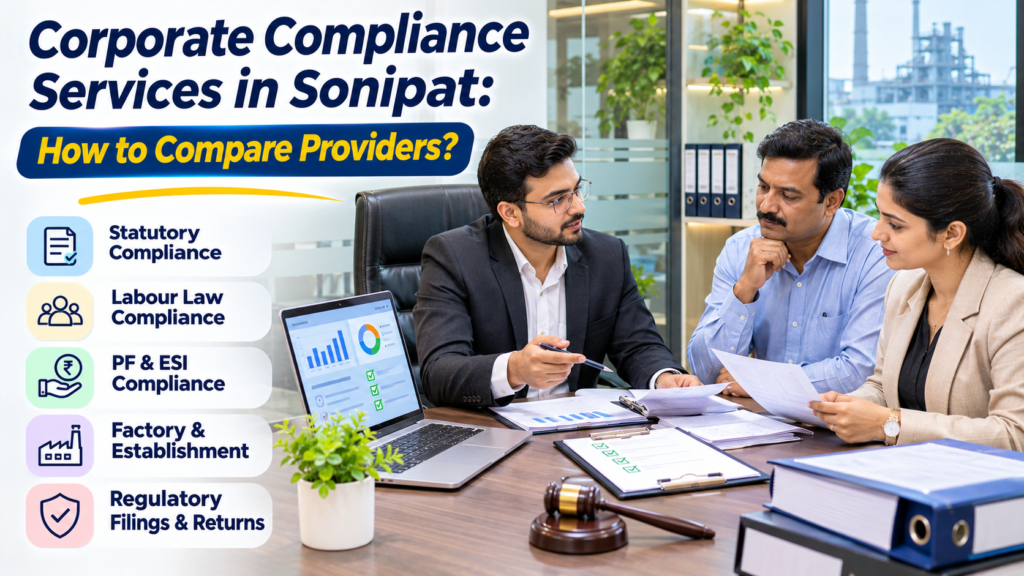
Running a business involves more than managing daily operations, employees, production and customer relationships. Every organisation must also follow applicable legal, statutory and regulatory requirements. From company-related filings and labour law obligations to employee records and workplace registrations, businesses need to manage several compliance responsibilities throughout the year.
For companies operating in industrial and commercial areas of Sonipat, these responsibilities can become increasingly complex as their workforce, operations and business activities expand. Manufacturing units, factories, warehouses, offices and growing enterprises may need regular support to manage different compliance requirements.
This is why many organisations consider hiring professional corporate compliance service providers.
However, choosing the right provider requires careful evaluation. Not every consultancy offers the same services, industry experience, reporting practices or level of support. Comparing providers only on the basis of service charges may lead to problems later.
Businesses searching for corporate compliance services in Sonipat should understand what services they need, how to evaluate consultants, which questions to ask and how to compare service providers before making a decision.
This guide explains the important factors businesses should consider when comparing corporate compliance firms in Sonipat, Kundli, Rai Industrial Area, Barhi Industrial Area and nearby business locations.
1. Understand What Corporate Compliance Services Include
Before comparing corporate compliance firms, businesses should understand the type of support they actually require.
Corporate compliance refers to following applicable laws, regulations, statutory requirements and internal governance obligations relevant to a business.
The exact requirements depend on the organisation’s legal structure, industry, workforce size, location and business activities.
Professional corporate compliance support may include several areas.
A. Company Law and Corporate Secretarial Compliance
Businesses registered under applicable company laws may have ongoing statutory and governance responsibilities.
Depending on the company’s structure and legal requirements, support may include:
- Assistance with statutory filing requirements.
- Maintenance of prescribed company records.
- Preparation and maintenance of statutory registers.
- Assistance with annual compliance activities.
- Documentation related to board and shareholder meetings.
- Corporate record management.
- Coordination for applicable regulatory submissions.
Companies should confirm whether the provider has the appropriate qualifications and professional expertise for the specific corporate secretarial services being offered.
B. Labour Law Compliance
Organisations employing workers may have different labour law obligations depending on their establishment, workforce and applicable legislation.
Labour compliance support may involve:
- Review of applicable labour law requirements.
- Employee documentation and record maintenance.
- Assistance with statutory registers.
- Wage and salary-related compliance documentation.
- Support with applicable labour returns.
- Guidance regarding workplace statutory obligations.
- Assistance with labour-related inspections and documentation.
Manufacturing companies and industrial units should pay particular attention to labour compliance because workforce-related requirements can involve multiple responsibilities.
C. Provident Fund (PF) Compliance
Eligible establishments may have obligations under the Employees’ Provident Funds and Miscellaneous Provisions Act, 1952, and related schemes.
Depending on applicability, PF compliance assistance may include:
- Employer registration guidance.
- Employee PF documentation.
- Monthly contribution-related coordination.
- Electronic challan and return-related assistance.
- Employee details and record verification.
- Support with PF-related corrections and queries.
Businesses should clarify whether the provider handles the entire process or only provides documentation and advisory assistance.
D. Employees’ State Insurance (ESI) Compliance
The Employees’ State Insurance (ESI) framework provides applicable social security benefits to eligible employees.
Depending on the establishment and applicable coverage requirements, compliance support may include:
- ESI registration assistance.
- Employee registration guidance.
- Contribution-related documentation.
- Record verification.
- Assistance with applicable returns and submissions.
- Guidance regarding employee medical benefit procedures.
E. Factory and Industrial Establishment Compliance
Manufacturing units may have additional regulatory responsibilities depending on their operations, workforce and applicable laws.
These may include assistance with:
- Applicable factory-related registrations and licences.
- Documentation and record maintenance.
- Coordination for statutory inspections.
- Workplace compliance documentation.
- Renewal and validity tracking.
- Guidance regarding applicable industrial establishment requirements.
A business should verify whether the provider understands the regulatory requirements relevant to its particular industrial activity.
2. Why Businesses in Sonipat Need Professional Compliance Support
Sonipat has several industrial and commercial areas where manufacturing units, warehouses, service businesses and other establishments operate.
Locations such as Rai Industrial Area, Kundli Industrial Area, Barhi Industrial Area, Murthal Industrial Area and IMT Kharkhoda have different types of business operations and workforce requirements.
As businesses grow, their compliance responsibilities may also increase.
For example, a manufacturing company employing a larger workforce may need to manage employee documentation, PF and ESI obligations, wage-related records and other applicable statutory requirements.
Similarly, a company operating multiple establishments may need to coordinate compliance activities across different locations.
Professional corporate compliance support can help businesses:
- Understand their applicable statutory obligations.
- Organise compliance documentation.
- Track important filing and renewal dates.
- Maintain employee-related records.
- Reduce administrative workload.
- Identify documentation gaps.
- Coordinate compliance-related activities.
- Prepare for applicable inspections and verification.
However, hiring a consultant does not automatically transfer the company’s legal responsibility to the service provider. Employers and company management must continue to ensure that their statutory obligations are fulfilled.
3. How to Compare Corporate Compliance Firms in Sonipat
Choosing a corporate compliance provider should involve more than checking a website or asking for a quotation.
Businesses should compare providers using clear evaluation criteria.
1. Compare the Range of Services Offered
The first step is to understand exactly which services each provider offers.
Some consultants specialise in PF and ESI-related assistance, while others provide broader labour law, company law and statutory compliance support.
Before selecting a provider, prepare a list of your organisation’s requirements.
For example:
| Compliance Requirement | What to Check |
|---|---|
| Company Law Compliance | Annual filings, statutory records and applicable corporate documentation |
| Labour Law Compliance | Applicable registers, returns and labour-related documentation |
| PF Compliance | Registration, employee records and contribution-related support |
| ESI Compliance | Registration, employee records and contribution-related assistance |
| Factory Compliance | Applicable licences, records and statutory requirements |
| Compliance Documentation | Accuracy, maintenance and availability of records |
| Compliance Monitoring | Due-date tracking and follow-up procedures |
Compare the actual scope of services instead of assuming that every corporate compliance company provides the same solutions.
2. Evaluate Industry Experience
Industry experience is another important factor.
Compliance requirements can vary between manufacturing units, trading businesses, warehouses, service companies and corporate offices.
For example, a manufacturing company may have different labour-related responsibilities compared with a small professional services firm.
When comparing corporate compliance consultants in Sonipat, ask:
- Have they worked with businesses in your industry?
- Do they understand manufacturing-related compliance requirements?
- Have they supported companies with similar workforce sizes?
- Are they familiar with applicable industrial establishment requirements?
- Can they explain compliance responsibilities clearly?
A provider with relevant experience may be better equipped to understand your operational requirements.
However, businesses should verify experience through genuine references, qualifications and documented service credentials rather than relying only on promotional claims.
3. Check Knowledge of Applicable Laws and Regulations
Compliance requirements can change due to amendments, notifications, regulatory updates and changes in applicable rules.
A reliable provider should understand the current legal framework relevant to the services being offered.
Ask how the provider:
- Monitors regulatory changes.
- Communicates changes to clients.
- Identifies newly applicable requirements.
- Updates documentation and compliance processes.
- Handles questions involving regulatory interpretation.
For complex legal matters, businesses should confirm whether the provider has qualified professionals or coordinates with appropriately qualified legal or compliance specialists.
4. Compare Transparency in Service Charges
Pricing is an important consideration when selecting corporate compliance service providers.
However, the lowest quotation does not necessarily represent the best value.
Corporate compliance service charges may vary depending on:
- Number of employees.
- Type of establishment.
- Number of registrations.
- Monthly compliance workload.
- Number of locations.
- Frequency of statutory filings.
- Complexity of documentation.
- Additional advisory requirements.
Some providers may charge separately for registration, monthly compliance, annual filings and additional documentation.
Before finalising an agreement, ask for a written quotation that clearly explains the scope of work.
Check whether the quoted amount includes:
- Professional service fees.
- Routine documentation.
- Applicable filing assistance.
- Monthly compliance coordination.
- Renewal-related support.
- Additional consultation charges.
- Government fees or statutory payments, where applicable.
A transparent pricing structure helps businesses avoid misunderstandings and unexpected expenses.
5. Review Documentation and Reporting Practices
Accurate documentation is an important part of corporate compliance management.
A provider should have a clear process for collecting, reviewing, organising and maintaining relevant records.
Ask how they manage:
- Employee information.
- Registration documents.
- Statutory registers.
- Filing acknowledgements.
- Contribution records.
- Compliance reports.
- Renewal documents.
- Previous submissions.
Businesses should also understand how they can access their own records when required.
A proper documentation process makes it easier to verify completed work and respond to applicable regulatory requirements.
6. Evaluate Communication and Response Time
Corporate compliance often involves deadlines and information requests.
Delayed communication can create unnecessary administrative difficulties, especially when a business needs clarification about a filing, employee record or statutory requirement.
During the initial discussion, evaluate:
- How quickly the provider responds.
- Whether service responsibilities are clearly explained.
- Whether a dedicated contact person is available.
- How urgent issues are handled.
- Whether clients receive regular updates.
- Whether communication is documented.
A provider should be able to explain the status of assigned work without creating confusion.
7. Check Compliance Tracking and Follow-Up Systems
Businesses should understand how a compliance provider tracks important due dates.
A structured tracking process may include:
- Monthly compliance calendars.
- Filing and payment reminders.
- Registration renewal alerts.
- Pending document lists.
- Submission status updates.
- Periodic compliance reviews.
Ask whether reminders are shared in advance and how pending information is followed up.
A well-organised system can help management stay informed about upcoming compliance responsibilities.
8. Understand Data Security and Confidentiality
Corporate compliance work involves sensitive business and employee information.
Documents may include identity details, salary information, bank-related information, employee records and company registrations.
Before sharing information, businesses should understand the provider’s data-handling practices.
Consider asking:
- How are client documents stored?
- Who can access employee information?
- Are documents shared through secure channels?
- How is confidential information protected?
- What happens when the service agreement ends?
A written confidentiality agreement and clearly defined data-handling responsibilities can help establish expectations.
4. Corporate Compliance Firms in Sonipat vs Outsourced Compliance Services
Businesses generally have two broad approaches to managing compliance responsibilities: handling them internally or outsourcing selected activities to an external service provider.
Both approaches have advantages and limitations.
| Factor | In-House Compliance Management | Corporate Compliance Outsourcing |
|---|---|---|
| Staffing | Requires internal employees | External professional support |
| Operational Control | Direct internal coordination | Depends on the service agreement |
| Cost Structure | Salaries, training and software expenses | Agreed professional service charges |
| Expertise | Depends on internal team capabilities | Depends on the provider’s qualifications |
| Workload | Managed internally | Selected activities handled externally |
| Documentation | Maintained by internal staff | Managed according to agreed responsibilities |
| Scalability | May require additional hiring | Scope may be adjusted as business needs change |
For smaller businesses, outsourcing selected compliance activities may reduce administrative workload.
Larger organisations may prefer an internal compliance team supported by external specialists.
The right approach depends on business size, complexity, risk and available resources.
5. Special Considerations for Manufacturing Companies
Manufacturing businesses often have more complex compliance requirements because of their workforce structure and industrial operations.
Companies operating in Rai Industrial Area, Kundli Industrial Area, Barhi Industrial Area, Murthal Industrial Area and IMT Kharkhoda should evaluate providers based on their understanding of manufacturing-related compliance requirements.
Important areas to discuss include:
Employee and Workforce Records
Manufacturing units may need to maintain employee details, attendance-related records, wage documentation and other applicable statutory registers.
PF and ESI Requirements
Businesses should understand whether PF and ESI provisions apply to their establishment and employees.
The service provider should be able to explain the relevant requirements and assist with applicable documentation.
Contract Labour Documentation
Where contract labour is engaged, additional compliance responsibilities may apply depending on the nature of the arrangement and applicable law.
Businesses should clarify whether the provider can support relevant documentation and coordination requirements.
Factory-Related Documentation
Depending on the establishment and applicable regulations, manufacturing units may require factory licences, statutory records, safety-related documentation and other approvals.
Multiple Establishments
Companies operating more than one unit should clarify whether the service provider can manage compliance responsibilities across different locations.
A provider’s ability to coordinate documentation and reporting across multiple establishments can be an important selection factor.
6. Questions to Ask Before Hiring a Corporate Compliance Consultant
Before signing an agreement, businesses should ask specific questions to understand the provider’s capabilities.
Here are some useful questions:
- Which corporate compliance services do you provide?
- Do you support manufacturing companies and industrial establishments?
- Do you provide PF and ESI compliance assistance?
- Can you support labour law documentation and statutory records?
- What experience do you have with businesses in Sonipat?
- Do you provide compliance calendars and due-date reminders?
- How are monthly compliance activities tracked?
- Will we receive reports and filing acknowledgements?
- What is included in your professional service charges?
- Are registration and renewal services charged separately?
- How do you communicate regulatory updates?
- Who will be our primary contact person?
- How do you protect confidential employee information?
- Can you provide references from relevant business clients?
- What are the responsibilities of our company and your consultancy under the service agreement?
The answers can help management compare providers more objectively.
7. Common Mistakes Businesses Make When Choosing Compliance Providers
Selecting a provider without proper evaluation can create operational and documentation problems.
Businesses should avoid the following mistakes.
Choosing Only on the Basis of Price
A low quotation may not include all the services required by the organisation.
Always compare the scope of work before comparing charges.
Not Checking Professional Qualifications
Different compliance activities may require specific professional qualifications or authorisations.
Businesses should verify whether the provider is appropriately qualified for the work being offered.
Ignoring Industry Requirements
A consultant familiar with a small office may not necessarily have experience with a manufacturing unit employing a large workforce.
Check relevant industry experience.
Not Defining Responsibilities
The company and the service provider should clearly understand who is responsible for collecting documents, reviewing information, completing submissions and tracking deadlines.
Ignoring Data Security
Employee and business records should not be shared without understanding how the information will be handled.
Failing to Review Service Agreements
The agreement should clearly explain the scope of services, fees, responsibilities, reporting process, confidentiality terms and conditions for ending the engagement.
8. How to Create a Corporate Compliance Firm Comparison Checklist
A comparison checklist helps businesses evaluate multiple providers using the same criteria.
Instead of relying on verbal promises, management can record the information received from each consultancy.
| Evaluation Criteria | Provider A | Provider B | Provider C |
|---|---|---|---|
| Service Coverage | |||
| Industry Experience | |||
| PF and ESI Support | |||
| Labour Law Compliance | |||
| Company Law Support | |||
| Factory Compliance Assistance | |||
| Documentation Process | |||
| Compliance Tracking System | |||
| Reporting Frequency | |||
| Communication and Support | |||
| Data Security Practices | |||
| Professional Qualifications | |||
| Monthly Service Charges | |||
| Additional Charges | |||
| Client References |
Businesses can use this checklist during meetings with corporate compliance firms in Sonipat and Kundli.
The final decision should consider service quality, professional expertise, transparency and the organisation’s actual requirements.
9. Corporate Compliance Services Across Sonipat and Nearby Industrial Areas
Businesses operating in different parts of Sonipat may have different compliance requirements depending on their activities and workforce.
When searching for corporate compliance support, companies may consider providers familiar with their business location.
Rai Industrial Area
Manufacturing and industrial establishments can evaluate providers based on their understanding of applicable workforce documentation, statutory records and industrial compliance requirements.
Kundli Industrial Area
Companies operating in Kundli may require assistance with employee-related compliance, PF and ESI documentation and other applicable statutory responsibilities.
Businesses searching for a corporate compliance consultant near Kundli Industrial Area should compare service coverage, industry experience and response time.
Barhi Industrial Area
Industrial establishments in Barhi can evaluate providers based on their ability to support relevant registrations, documentation and compliance coordination.
IMT Kharkhoda
As business activities develop in IMT Kharkhoda, organisations should understand the statutory requirements applicable to their specific operations.
Murthal Industrial Area
Businesses in and around Murthal may require professional support for workforce records, applicable labour law requirements and corporate documentation.
Other Sonipat Business Locations
Companies operating in Model Town, Sector 7, Sector 8, Sector 12, Sector 14, Sector 15, Sector 23, Sector 27 and Sector 30 Sonipat may also explore professional compliance support according to their organisational needs.
Businesses in Ganaur, Gohana, Kharkhoda, Rai Village, Kundli, Rasoi, Jakhauli, Khewra, Bahadurgarh and nearby areas should evaluate providers based on their actual service coverage.
Organisations with operations across Sonipat, Panipat, Bahadurgarh and Delhi NCR should also confirm whether the provider can coordinate compliance activities across multiple establishments.
10. Why Choose a Corporate Compliance Service Provider With a Clear Process?
A professional relationship should be based on transparency, communication and clearly defined responsibilities.
Businesses should look for providers that follow a structured approach rather than offering general assurances.
A clear service process generally includes:
Initial Requirement Assessment: Understanding the organisation’s legal structure, industry, workforce and applicable compliance requirements.
Scope Definition: Identifying the services that will be handled by the provider and the responsibilities retained by the business.
Document Collection: Creating a structured list of required company and employee documents.
Compliance Planning: Preparing a schedule for applicable filings, payments, registrations and renewals.
Execution and Coordination: Handling agreed compliance activities and coordinating with the company’s authorised representatives.
Reporting: Sharing relevant updates, submission acknowledgements and pending document requirements.
Periodic Review: Reviewing the process and identifying gaps that may need attention.
This structured approach can help organisations maintain better visibility over their compliance responsibilities.
11. Corporate Compliance Support for Businesses Through V.P. Associates
Businesses searching for corporate compliance services in Sonipat can explore professional support from V.P. Associates.
Before selecting any compliance consultancy, companies should identify their requirements and discuss the specific services they need.
Businesses can use an initial discussion to understand the available assistance, documentation process, service responsibilities and applicable professional charges.
Companies may discuss requirements related to corporate compliance, labour law documentation, employee-related statutory obligations and other relevant compliance activities, subject to the services currently offered by the consultancy.
For organisations operating in Sonipat, Kundli Industrial Area, Rai Industrial Area, Barhi Industrial Area and nearby business locations, selecting a provider with a clear understanding of their operational requirements can make compliance coordination easier.
To understand the available services and discuss your business requirements, visit the official website:
Businesses should confirm the exact service scope, professional qualifications, fees and engagement terms directly with V.P. Associates before proceeding.
Frequently Asked Questions (FAQs)
1. What are corporate compliance services?
Corporate compliance services involve professional assistance with applicable legal, statutory, regulatory and documentation requirements of a business. Depending on the organisation, these may include company law, labour law, PF, ESI and other establishment-related compliance activities.
2. How do I choose a corporate compliance firm in Sonipat?
Compare providers based on their service coverage, relevant industry experience, professional qualifications, documentation process, communication, reporting practices, data security and service charges.
3. What is the difference between corporate compliance consultants and company secretaries?
Corporate compliance consultants may provide different types of statutory and regulatory assistance depending on their qualifications and services. A Company Secretary is a recognised professional qualification with specific responsibilities under applicable company law. Not every compliance consultant is a Company Secretary.
4. What factors affect corporate compliance service charges?
Charges may depend on the number of employees, type of establishment, number of registrations, monthly workload, number of business locations and complexity of compliance requirements.
5. Do manufacturing companies need specialised compliance support?
Manufacturing companies may have additional compliance responsibilities related to their workforce, factory operations, statutory records and applicable labour laws. They should select a provider familiar with the requirements relevant to their operations.
6. Can businesses outsource corporate compliance activities?
Yes. Businesses may outsource selected compliance activities to qualified external professionals. However, outsourcing does not automatically remove the legal responsibilities of the company, employer or its management.
7. What documents may be required for corporate compliance services?
Depending on the services involved, documents may include company registration details, establishment information, employee records, wage details, attendance records, PF and ESI information, previous filing acknowledgements and relevant licences.
8. Are corporate compliance services available for companies in Kundli Industrial Area?
Businesses operating in Kundli Industrial Area can explore corporate compliance providers serving the region. They should confirm the provider’s service coverage and experience with their specific industry requirements.
9. How often should a business review its compliance requirements?
Businesses should monitor applicable compliance obligations throughout the year. Periodic reviews are useful when there are changes in workforce size, business operations, company structure or applicable regulations.
10. Why should businesses compare multiple compliance providers?
Comparing multiple providers helps businesses understand differences in service scope, qualifications, experience, reporting systems and pricing. It supports a more informed decision based on actual organisational requirements.
Conclusion
Choosing the right corporate compliance service provider is an important business decision. Companies need more than a low-cost quotation; they need a provider who understands their industry, explains applicable responsibilities and follows a transparent process.
Before selecting corporate compliance firms in Sonipat, businesses should compare service coverage, professional qualifications, industry experience, documentation practices, reporting systems, communication and service charges.
Manufacturing companies and industrial establishments operating in Rai Industrial Area, Kundli Industrial Area, Barhi Industrial Area, Murthal Industrial Area and IMT Kharkhoda should pay particular attention to workforce-related and establishment-specific compliance requirements.
A structured comparison can help businesses identify a suitable service provider and establish a more organised approach to ongoing compliance management.
For organisations exploring corporate compliance services in Sonipat, V.P. Associates is an option to contact for information about available services and business compliance requirements. Discuss your organisation’s needs, confirm the scope of assistance and review the engagement terms before making a final decision.
Leave a Reply