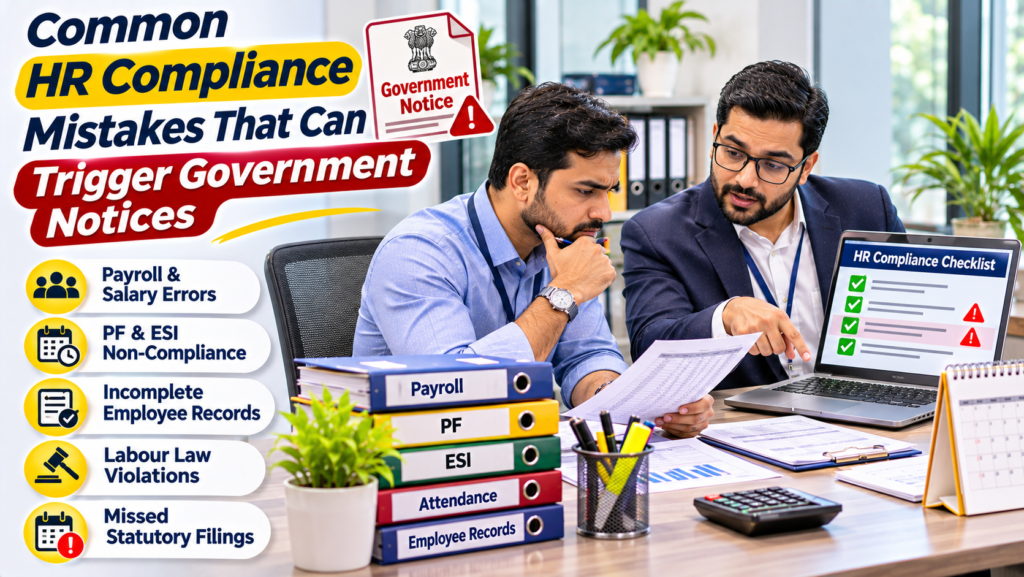
Managing employees involves several responsibilities beyond recruitment, salary processing, and attendance management. Every business must follow applicable labour laws, maintain accurate employee records, deposit statutory contributions, and complete required filings within prescribed timelines. Even a small mistake in payroll calculations, employee documentation, or statutory reporting can create compliance gaps and attract questions from government authorities.
For businesses operating in India, HR compliance mistakes can lead to notices, requests for clarification, inspections, financial penalties, interest, or other legal consequences, depending on the nature and seriousness of the issue.
Many compliance problems do not happen intentionally. They often result from outdated employee information, incorrect payroll calculations, missed deadlines, incomplete documentation, or a lack of coordination between HR and finance departments.
Understanding these common mistakes can help employers improve their internal processes and reduce the risk of receiving government labour department notices.
This guide explains the common HR statutory compliance errors, payroll-related mistakes, PF and ESI issues, and documentation gaps that businesses should identify and correct.
What Are HR Compliance Mistakes?
HR compliance mistakes are errors or omissions that occur when an organisation fails to follow applicable employment-related legal requirements.
These mistakes may happen during employee onboarding, payroll processing, statutory contribution payments, leave management, workplace administration, or record maintenance.
Common examples include:
- Incorrect employee salary calculations.
- Delayed PF or ESI contributions.
- Failure to follow applicable minimum wage requirements.
- Incomplete appointment letters.
- Missing attendance and leave records.
- Incorrect statutory deductions.
- Delayed statutory returns.
- Missing employee declarations.
- Inadequate contractor compliance verification.
- Failure to update HR policies after legal changes.
The consequences depend on the applicable law, the nature of the default, the establishment’s circumstances, and whether the employer takes corrective action.
Not every administrative error automatically results in a government notice. However, repeated mistakes or serious statutory defaults can increase the possibility of regulatory action.
Why Do Government Authorities Issue Labour Compliance Notices?
Government authorities may issue notices when they identify a possible violation, receive a complaint, find inconsistencies in submitted information, or require an employer to provide additional documents.
A notice may relate to:
- Delayed statutory payments.
- Incorrect employee contribution calculations.
- Missing or incomplete records.
- Non-submission of required returns.
- Minimum wage-related discrepancies.
- Employee complaints.
- Workplace safety concerns.
- Establishment registration or licensing issues.
- Contractor-related compliance gaps.
- Differences between payroll and statutory records.
Depending on the situation, an employer may receive a document request, clarification notice, show-cause notice, inspection communication, or another formal communication from the relevant authority.
Receiving a notice does not automatically establish that a company has committed a violation. Employers should examine the allegations, understand the applicable legal provisions, and respond appropriately within the specified timeline.
10 Common HR Compliance Mistakes That Can Trigger Government Notices
Understanding the most frequent compliance errors can help businesses review their HR systems and take preventive action.
1. Delayed PF Contributions and Incorrect Employee Details
Provident Fund compliance is an important responsibility for establishments covered under the applicable social security provisions.
Employers must identify eligible employees, calculate contributions correctly, maintain employee information, and complete the required filing and payment activities.
Common PF compliance mistakes include:
- Delaying monthly contribution payments.
- Incorrect UAN information.
- Missing eligible employees from payroll records.
- Incorrect PF wage calculations.
- Differences between payroll and ECR information.
- Failure to update employee joining and exit details.
- Incorrect employee contribution deductions.
- Incomplete supporting documentation.
For example, a company may calculate PF contributions using incorrect salary information. If the payroll records and submitted contribution details do not match, the discrepancy may require clarification.
How to avoid this mistake:
Maintain updated employee information, reconcile payroll data before filing, verify contribution calculations, and monitor payment acknowledgements.
HR and finance teams should also review PF records periodically rather than waiting until an inspection or notice occurs.
2. Errors in ESI Registration and Contributions
Employees’ State Insurance provides eligible employees with specified medical and social security benefits.
Employers covered under applicable ESI requirements must maintain employee registration details, calculate contributions, and complete the required contribution-related activities.
Common PF ESI compliance errors include:
- Not registering eligible employees.
- Incorrect insurance details.
- Missing employee information.
- Incorrect wage calculations.
- Delayed contribution payments.
- Differences between payroll and ESI records.
- Failure to update employee joining and exit information.
- Incomplete contribution documentation.
For example, an employee may be included in the company’s payroll but missing from the relevant ESI records because the HR team failed to complete the required registration process.
Such inconsistencies can create compliance problems.
How to avoid this mistake:
Review employee eligibility, verify insurance information, reconcile payroll with contribution records, and maintain payment acknowledgements.
Companies should also monitor changes in applicable coverage conditions and wage limits.
3. Paying Employees Below Applicable Minimum Wages
Paying employees below the applicable minimum wage is a serious wage compliance issue.
Minimum wage requirements depend on the relevant government notification, employee category, skill classification, geographical area, and nature of employment.
Businesses sometimes continue using outdated wage structures even after a government revision becomes applicable.
Common minimum wage-related mistakes include:
- Using outdated wage rates.
- Incorrectly classifying employee skill categories.
- Ignoring revised wage notifications.
- Making unauthorised salary deductions.
- Incorrectly calculating overtime payments.
- Maintaining inconsistent wage records.
For example, a manufacturing company may continue paying workers according to an older wage notification even after revised rates become applicable.
This can create wage-related disputes and regulatory scrutiny.
How to avoid this mistake:
Review applicable Central and State minimum wage notifications regularly. Update payroll structures whenever revisions become effective and verify that employee classifications are accurate.
Businesses operating in Haryana should pay particular attention to Haryana-specific wage notifications and applicable revisions.
4. Incorrect Payroll Calculations and Salary Deductions
Payroll errors are among the common payroll compliance mistakes that can create employee complaints and statutory discrepancies.
A salary calculation may involve basic wages, allowances, overtime, leave adjustments, statutory contributions, tax deductions, and other approved payments.
Errors in any of these areas can affect employee payments and statutory records.
Common payroll mistakes include:
- Incorrect salary structure.
- Wrong attendance calculations.
- Unauthorised deductions.
- Incorrect overtime payments.
- Missing salary adjustments.
- Inaccurate PF and ESI calculations.
- Incorrect TDS deductions.
- Differences between salary slips and bank payments.
For example, an employee’s attendance records may show 26 working days, while payroll calculations incorrectly account for fewer days. This can result in a salary dispute and require correction.
How to avoid this mistake:
Use a structured payroll verification process. Reconcile attendance, approved leave, salary revisions, deductions, and statutory contributions before processing monthly salaries.
Ensure that employees receive accurate wage information and that salary records are properly maintained.
5. Incomplete Employee Documentation
Employee documentation is essential for demonstrating that an organisation follows appropriate employment procedures.
Missing or inconsistent employee records can create problems during inspections, audits, disputes, and statutory verification.
Common HR documentation mistakes include:
- Missing appointment letters.
- Incomplete employee information forms.
- Outdated salary records.
- Missing employee declarations.
- Incorrect joining dates.
- Incomplete attendance records.
- Missing resignation documentation.
- Improper full and final settlement records.
- Unorganised leave information.
- Missing nomination details where required.
For example, an organisation may have employees working for several months without properly maintained appointment documentation.
If the relevant authority requests employment records, the company may struggle to provide complete information.
How to avoid this mistake:
Create a standard employee onboarding process and maintain a separate record for every employee.
Employee files should be updated whenever there is a change in designation, salary, department, employment status, or other relevant information.
6. Missing or Delayed Statutory Returns
Many employers must complete periodic statutory filings depending on their establishment and applicable legal requirements.
Missing a filing deadline or submitting inaccurate information can create compliance issues.
Common filing-related mistakes include:
- Forgetting applicable monthly filings.
- Submitting incomplete information.
- Incorrect employee details.
- Differences between payroll and return data.
- Missing supporting documents.
- Failing to retain filing acknowledgements.
- Not reviewing filing status after submission.
A company may believe that its compliance activity is complete simply because the payment has been made. However, payment and filing requirements may be separate obligations.
How to avoid this mistake:
Prepare a compliance calendar containing all applicable monthly, quarterly, annual, and event-based deadlines.
Assign responsibility to specific HR or finance team members and maintain proof of every required submission.
7. Ignoring Contractor and Contract Labour Compliance
Manufacturing companies, warehouses, construction-related businesses, and industrial establishments frequently engage contractors for different activities.
Examples include:
- Security services.
- Housekeeping.
- Loading and unloading.
- Packaging.
- Maintenance.
- Production support.
- Transportation.
- Facility management.
Employers should not assume that outsourcing work automatically removes all compliance responsibilities.
Depending on applicable law and the nature of the arrangement, responsibilities may involve contractor registration or licensing, employee records, wage payments, statutory contributions, and welfare arrangements.
Common contractor-related mistakes include:
- Not checking contractor documentation.
- Missing workforce details.
- Failure to verify wage payments.
- Incomplete attendance records.
- Not reviewing PF and ESI compliance evidence.
- Unclear contractual responsibilities.
- Missing or outdated contractor agreements.
How to avoid this mistake:
Maintain updated contractor agreements, collect relevant employee and statutory records, verify payment evidence, and conduct periodic contractor compliance reviews.
Companies should clearly define responsibilities between the principal employer and contractor.
8. Failure to Maintain Proper Attendance and Leave Records
Attendance and leave records directly affect payroll calculations and employee administration.
Incorrect or incomplete records can create disputes regarding working hours, overtime, leave deductions, and wage payments.
Common mistakes include:
- Missing attendance entries.
- Incorrect working-hour records.
- Unrecorded overtime.
- Incomplete weekly rest information.
- Incorrect leave balances.
- Missing holiday records.
- Differences between attendance and payroll data.
For example, a manufacturing unit may maintain attendance manually but fail to update records after shift changes. This can result in incorrect salary calculations.
How to avoid this mistake:
Use a consistent attendance management process. Review working hours, overtime, leave, and weekly rest records before monthly payroll processing.
Maintain records in the format and manner required by applicable rules.
9. Ignoring Workplace Safety and Employee Welfare Requirements
Workplace safety is particularly important for factories, warehouses, and manufacturing establishments.
Employers must identify workplace risks and follow applicable health, safety, and welfare requirements.
Common mistakes include:
- Inadequate safety arrangements.
- Missing protective equipment.
- Poor machinery safeguards.
- Incomplete safety training records.
- Improper emergency arrangements.
- Missing accident documentation.
- Inadequate welfare facilities.
- Failure to address reported workplace hazards.
For example, a manufacturing unit may require workers to operate machinery without providing suitable protective equipment or adequate safety instructions.
This can expose employees to unnecessary risks and may result in regulatory action.
How to avoid this mistake:
Conduct regular workplace safety reviews, provide appropriate protective equipment, maintain training records, and establish emergency procedures.
Manufacturing companies should also review applicable factory and workplace safety requirements according to their operations.
10. Not Updating HR Policies After Labour Law Changes
Employment-related laws, rules, notifications, and procedures can change over time.
Companies that continue using outdated HR policies may unintentionally follow incorrect procedures.
Common examples include:
- Outdated leave policies.
- Incorrect wage structures.
- Old employment agreement formats.
- Outdated overtime provisions.
- Incorrect statutory contribution procedures.
- Missing workplace policy updates.
- Failure to review state-specific requirements.
India’s four Labour Codes came into effect on 21 November 2025. Central Rules were subsequently notified in May 2026. Employers should review the applicable Central and State rules, notifications, and transitional requirements rather than continuing to rely only on older compliance checklists.
How to avoid this mistake:
Assign responsibility for monitoring legal updates. Review HR policies periodically and update internal processes whenever a relevant legal change becomes applicable.
How Do HR Compliance Errors Lead to Government Notices?
Different government authorities may monitor different areas of employment and statutory compliance.
The nature of a notice generally depends on the issue identified and the authority responsible for that particular requirement.
For example:
| Compliance Area | Possible Issue | Relevant Authority or Department |
|---|---|---|
| Provident Fund | Contribution discrepancies or delayed payments | EPFO |
| ESI | Incorrect contributions or registration issues | ESIC |
| Minimum Wages | Wage-related discrepancies | Relevant Labour Department or authority |
| Factory Compliance | Registration, safety, or workplace issues | Relevant State Factory Inspectorate or authority |
| TDS on Salary | Incorrect deduction or deposit | Income Tax Department |
| Contract Labour | Applicable contractor-related non-compliance | Relevant labour authority |
| POSH Compliance | Failure to meet applicable workplace obligations | Relevant District Officer or authority |
The precise authority and legal procedure depend on the applicable law and the nature of the establishment.
A notice may request records, explanations, payment details, or corrective action. Employers should not ignore such communication.
What Should a Company Do After Receiving a Government Labour Department Notice?
Receiving a notice can create concern for business owners and HR teams. However, responding systematically is important.
The following steps can help organisations manage the situation.
Step 1: Read the Notice Carefully
Identify the issuing authority, subject, relevant period, legal provision, requested documents, and response deadline.
Do not assume that every notice relates to the same type of violation.
Step 2: Verify the Authenticity of the Communication
Check the official department portal or contact the issuing authority through verified channels if necessary.
Avoid sharing confidential employee or financial information through unverified communication channels.
Step 3: Collect Relevant Records
Depending on the notice, documents may include:
- Employee records.
- Salary registers.
- Attendance details.
- PF and ESI challans.
- Payroll reports.
- Statutory return acknowledgements.
- Appointment letters.
- Contractor agreements.
- Wage payment records.
- Relevant licences and registrations.
Step 4: Identify the Actual Compliance Gap
Compare the information mentioned in the notice with the company’s internal records.
Determine whether the issue involves an incorrect calculation, delayed payment, missing document, reporting discrepancy, or another matter.
Step 5: Prepare an Accurate Response
Provide relevant explanations and supporting documents within the prescribed timeline.
If the matter involves a legal dispute, potential penalty, or complex statutory interpretation, seek advice from a qualified professional.
Step 6: Complete Corrective Actions
If an actual compliance gap is identified, take appropriate corrective steps according to the applicable law.
Maintain proof of payments, revised records, submissions, and other corrective actions.
Step 7: Maintain a Complete Communication Record
Keep copies of the notice, response, supporting documents, acknowledgements, and subsequent communication.
This helps the organisation maintain a clear record of how the matter was handled.
HR Compliance Checklist to Reduce the Risk of Government Notices
A regular internal review can help businesses identify common HR statutory compliance errors before they become serious issues.
The following checklist can be used as a starting point.
| Compliance Activity | Review Frequency |
|---|---|
| Employee appointment documentation | At joining and during periodic reviews |
| Employee information updates | Whenever details change |
| Attendance and leave records | Monthly |
| Payroll calculations | Monthly |
| Minimum wage compliance | Whenever wage rates change |
| PF contribution verification | Monthly, where applicable |
| ESI contribution verification | Monthly, where applicable |
| Salary TDS review | Monthly and quarterly, where applicable |
| Contractor documentation | Periodically |
| Statutory return verification | According to filing frequency |
| Workplace safety review | Periodically |
| HR policy review | When legal or operational changes occur |
| POSH compliance | Ongoing and annual reporting, where applicable |
| Employee exit documentation | At separation |
| Internal HR compliance audit | Periodically |
This checklist should be customised according to the company’s industry, employee strength, establishment classification, and applicable laws.
Why Should Businesses Conduct Regular HR Compliance Audits?
An HR compliance audit helps a company evaluate whether its existing HR practices are aligned with applicable legal requirements.
Instead of waiting for a notice or inspection, businesses can review their processes proactively.
A compliance audit may cover:
Employee documentation: Verify appointment letters, employee information, salary records, and exit documentation.
Payroll verification: Review salary calculations, deductions, overtime, and statutory contribution records.
PF and ESI review: Check applicable employee coverage, contribution calculations, payment records, and filings.
Wage compliance: Compare salary structures with applicable minimum wage notifications.
Contractor compliance: Review contractor agreements, employee details, wage records, and statutory evidence.
Policy review: Check whether HR policies reflect current applicable requirements.
Filing verification: Confirm that relevant returns and statutory submissions have been completed.
The audit should result in a list of identified gaps, recommended corrective actions, responsible persons, and completion timelines.
HR Compliance Challenges for Businesses in Sonipat and Nearby Industrial Areas
Businesses operating in Sonipat and surrounding industrial locations may face different compliance challenges depending on their workforce, business activities, and establishment type.
Manufacturing companies in Rai Industrial Area, Kundli Industrial Area, Barhi Industrial Area, IMT Kharkhoda, and Murthal Industrial Area may need to manage production-worker documentation, shift attendance, contractor records, statutory contributions, and workplace safety requirements.
Commercial establishments in Model Town Sonipat, Sector 7, Sector 8, Sector 12, Sector 14, Sector 15, Sector 23, Sector 27, and Sector 30 may have different HR and payroll compliance responsibilities.
Businesses operating around Atlas Road, Subhash Chowk, Geeta Bhawan Chowk, Railway Road, Kakroi Road, Gohana Road, and Murthal Road should also review their applicable establishment-related obligations.
Companies in Murthal, Ganaur, Gohana, Kharkhoda, Nahra, Nahri, Rathdhana, Kami, Kakroi, Bajana Kalan, Tajpur, Pipli Khera, Purkhas, Ridhau, Rai Village, Jakhauli, Khewra, Sisana, Garhi Sisana, Rohna, Farmana, Jataula, Jharaut, Kundal, Kundli, Rasoi, Liwana, Patti Kalan, Jatheri, and Bainapur may also benefit from a structured HR compliance review.
Businesses with operations in Panipat, Bahadurgarh, and Delhi NCR should consider applicable state-specific requirements wherever they operate.
V.P. Associates can be approached by businesses seeking information about corporate compliance and labour law-related assistance. Companies should directly confirm the specific services available, the scope of professional support, and the requirements of their establishment before proceeding.
Conclusion
HR compliance mistakes can create unnecessary difficulties for businesses, particularly when errors involve statutory contributions, payroll calculations, employee documentation, wage payments, or workplace safety.
Many of these problems can be reduced through accurate record maintenance, regular payroll verification, timely statutory filings, contractor monitoring, and periodic internal audits.
Businesses should not wait until a government notice arrives to review their HR processes. A structured compliance calendar and clearly assigned responsibilities can help identify potential gaps early.
Whether your company operates in Sonipat, Rai Industrial Area, Kundli Industrial Area, Barhi Industrial Area, IMT Kharkhoda, Murthal, Ganaur, Gohana, or nearby locations, maintaining an organised HR compliance system is an important part of responsible business management.
If your internal team is finding it difficult to manage statutory responsibilities, consider seeking guidance from a qualified HR or labour law compliance professional. Regular reviews and timely corrective action can help businesses manage their obligations more effectively.
Disclaimer: This article provides general information and is not a substitute for legal advice. Labour law requirements, statutory procedures, thresholds, forms, and filing deadlines may change. Employers should verify the latest Central and Haryana Government notifications and seek appropriate professional advice before taking compliance decisions.
Leave a Reply