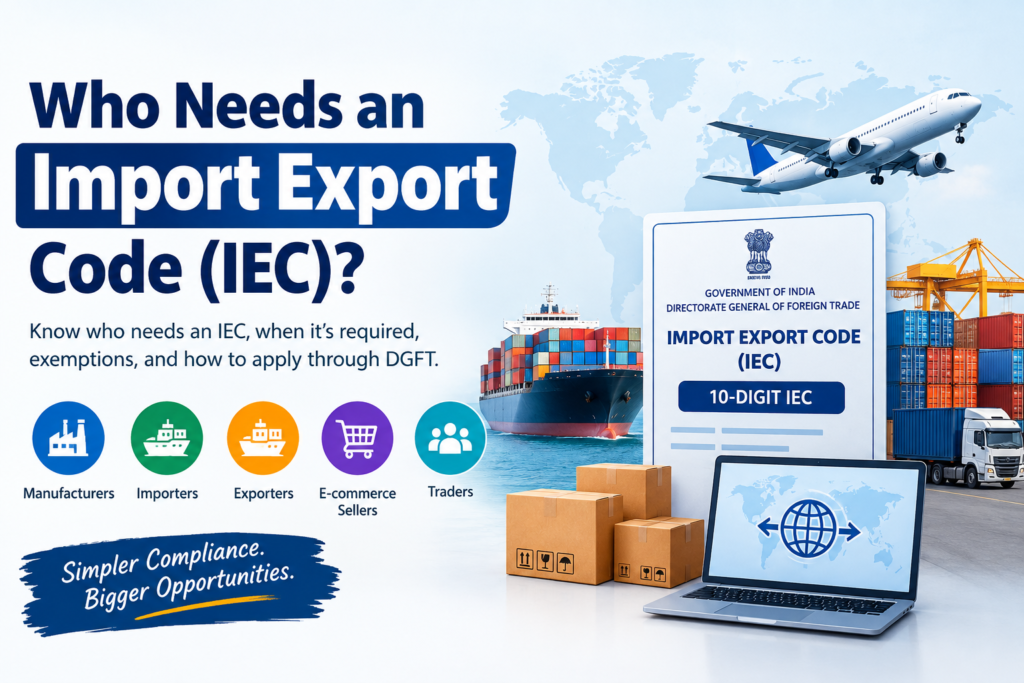
If you are planning to import goods into India or export goods from India, one of the important registrations you may need is an Import Export Code (IEC). IEC is a unique identification number issued by the Directorate General of Foreign Trade (DGFT) and is generally required for businesses involved in international trade.
But does every business need an IEC? The answer depends on the nature of your transactions and applicable exemptions.
What Is an Import Export Code (IEC)?
An Import Export Code is a unique 10-digit identification number used by businesses and other eligible persons involved in import or export activities.
It helps regulatory authorities identify businesses participating in international trade and is commonly required for customs clearance and certain foreign trade transactions.
IEC is generally linked to the business’s PAN and is obtained through the DGFT system.
Who Needs an IEC?
1. Businesses Importing Goods into India
If your business purchases goods from another country and brings those goods into India for business purposes, you will generally need an IEC.
For example:
- A manufacturer importing machinery
- A wholesaler importing products
- A retailer sourcing products from overseas
- A business importing raw materials
An IEC may be required to complete the applicable import and customs formalities.
2. Businesses Exporting Goods from India
Businesses selling goods to customers outside India generally require an IEC for export-related transactions.
This can include:
- Manufacturers
- Traders
- Wholesalers
- Online sellers
- E-commerce businesses
- Export houses
- Small and medium-sized businesses
Whether you are exporting products occasionally or regularly, it is important to check the applicable IEC requirements before starting international shipments.
3. E-Commerce Sellers Engaged in International Trade
With the growth of international e-commerce, many small businesses sell Indian products to customers abroad.
If you are using an online marketplace or your own website to export goods, you may need an IEC depending on the nature of your transactions and applicable rules.
Before accepting international orders, businesses should understand the relevant DGFT, customs, GST and shipping requirements.
4. Manufacturers Importing Raw Materials
Manufacturers often import raw materials, components, machinery or equipment from other countries.
For example, a manufacturing company may import:
- Electronic components
- Industrial machinery
- Packaging materials
- Chemicals or raw materials
- Specialized equipment
Such businesses should check IEC requirements before beginning import operations.
5. Traders Involved in International Buying and Selling
Import-export traders who purchase products from foreign suppliers and sell products to international customers may also require an IEC.
For businesses operating in this area, proper documentation and compliance are important because international transactions can involve customs, taxation, banking and foreign trade regulations.
Who May Not Need an IEC?
IEC is not necessarily required for every foreign-related transaction.
There are specific exemptions under applicable foreign trade regulations. For example, certain imports or exports may be exempt depending on the nature of the transaction, the person involved, or the purpose of the shipment.
Therefore, businesses should not assume that every international transaction automatically requires IEC—or that an exemption applies without checking the current rules.
Is IEC Required for Services?
The requirement can differ for service providers compared with businesses importing or exporting physical goods.
A service provider receiving payments from overseas does not automatically fall into exactly the same IEC requirements as a business exporting physical products. However, IEC may become relevant in specific situations, such as when the service provider is taking advantage of certain benefits or dealing with specified foreign trade requirements.
It is therefore important to examine the exact nature of the transaction.
Why Is IEC Important?
Having the appropriate IEC can help businesses complete various international trade formalities.
Some key reasons businesses obtain an IEC include:
- Facilitating import and export transactions
- Supporting customs-related procedures
- Identifying the business in foreign trade transactions
- Supporting international shipping documentation
- Helping businesses comply with applicable DGFT requirements
How Can You Apply for an IEC?
An IEC application is generally made online through the DGFT portal.
A business should keep the required details and documents ready and ensure that the information provided in the application is accurate.
The basic process generally involves:
- Registering or logging into the DGFT portal.
- Selecting the option for applying for IEC.
- Providing the required business and applicant details.
- Entering PAN and other required information.
- Uploading or providing the applicable documents and details.
- Paying the prescribed application fee.
- Submitting the application.
- Downloading the IEC after it is issued.
The exact process and requirements can change, so businesses should check the latest DGFT instructions before applying.
Common Mistakes Businesses Should Avoid
Businesses planning to enter international trade should be careful about:
- Starting imports or exports without checking IEC requirements
- Providing incorrect PAN or business details
- Ignoring customs documentation
- Not checking whether a particular product has additional restrictions
- Assuming IEC alone completes all import-export compliance
- Failing to keep business information updated
- Ignoring GST, customs, banking and other applicable requirements
Final Thoughts
An Import Export Code (IEC) is an important requirement for many businesses involved in importing or exporting goods in India. Manufacturers, traders, exporters, importers and certain e-commerce businesses may need an IEC before carrying out international trade activities.
However, IEC is only one part of import-export compliance. Depending on the transaction, businesses may also need to consider GST, customs regulations, product-specific permissions, banking requirements and other applicable laws.
If you are planning to start an import-export business, understanding your compliance requirements before making your first international shipment can help you avoid unnecessary delays and documentation issues.
Leave a Reply