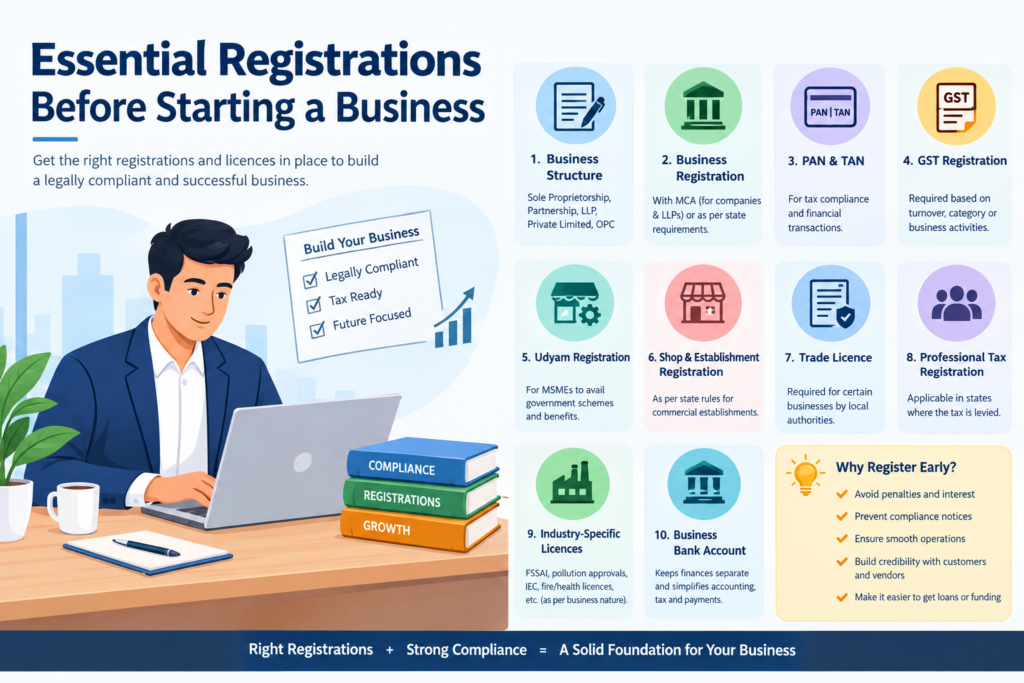
Starting a business is an exciting step, but turning an idea into a legally compliant business requires more than just choosing a name and selling products or services. Before beginning operations, business owners should understand which registrations, licences, and approvals may apply to their business.
The exact requirements depend on factors such as the type of business, location, number of employees, turnover, nature of activities, and whether the business operates online or offline.
1. Choose the Right Business Structure
The first step is to decide the legal structure of your business. Common options in India include:
- Sole Proprietorship
- Partnership Firm
- Limited Liability Partnership (LLP)
- Private Limited Company
- One Person Company (OPC)
The right structure can affect taxation, liability, compliance requirements, fundraising, and the way the business operates.
2. Business Registration
Depending on the selected structure, the business may need to be formally registered with the appropriate authority.
For companies and LLPs, registration with the Ministry of Corporate Affairs (MCA) is generally required. A partnership firm may have different registration requirements depending on the state and business circumstances.
Proper registration gives the business a formal legal identity and can make it easier to open a business bank account, enter contracts, apply for certain registrations, and establish credibility.
3. PAN and TAN
A Permanent Account Number (PAN) is important for tax-related activities and financial transactions.
Businesses that are required to deduct or collect tax at source may also need a Tax Deduction and Collection Account Number (TAN).
Having the correct tax registrations from the beginning helps prevent problems during compliance and filing.
4. GST Registration
Goods and Services Tax (GST) registration may be required when a business crosses the applicable turnover threshold or falls under specific categories where registration is mandatory.
GST registration can also be relevant for businesses involved in certain interstate supplies, e-commerce activities, or other situations prescribed under GST law.
Business owners should check their specific circumstances rather than assuming that every business automatically needs GST registration from day one.
5. Udyam Registration for MSMEs
If your business qualifies as a Micro, Small or Medium Enterprise, Udyam Registration can be useful.
It provides formal recognition as an MSME and may help eligible businesses access certain government schemes, benefits, and support programmes.
Although it may not be mandatory for every business, eligible entrepreneurs should evaluate whether registration would be beneficial for them.
6. Shop and Establishment Registration
Businesses operating from a physical commercial location may need registration under the applicable Shops and Establishments law of their state.
The requirements can cover areas such as working hours, holidays, employment conditions, records, and other workplace-related matters.
Since rules vary from state to state, businesses should check the requirements applicable to their location.
7. Trade https://vpassociatess.in/Licence
Certain businesses may require a trade licence or local municipal approval before starting operations.
This can depend on the nature of the business and the local authority’s rules. Restaurants, manufacturing units, shops, and certain service businesses may have additional local requirements.
Starting operations without a required local licence can create compliance issues later.
8. Professional Tax Registration
In states where professional tax applies, eligible employers and professionals may need to obtain the relevant registration and comply with applicable payment and filing requirements.
This requirement is location-specific, so businesses should verify whether professional tax applies in their state.
9. Industry-https://vpassociatess.in/Specific Licences
Some businesses require additional approvals because of the nature of their activities.
For example:
- Food businesses may require FSSAI registration or licence
- Certain manufacturing activities may require pollution-related approvals
- Importers and exporters may require IEC
- Businesses dealing with specific regulated products may require special licences
- Certain establishments may require fire, health, or local authority approvals
The registrations should be identified based on the actual activities of the business.
10. Business Bank Account
Once the necessary business documents are in place, opening a dedicated business bank account is an important step.
Keeping business transactions separate from personal transactions makes accounting easier and provides clearer financial records.
It can also help with tax compliance, financial reporting, vendor payments, and professional business operations.
11. Why Registrations Should Be Completed Early
Many new entrepreneurs focus primarily on sales and marketing and postpone compliance until the business becomes successful.
This can create unnecessary problems.
Missing a required registration or licence may result in:
- Penalties or interest
- Compliance notices
- Delays in business operations
- Difficulty dealing with customers or vendors
- Problems during tax filings
- Complications while applying for loans or funding
Getting the compliance structure right at the beginning can save considerable time and effort later.
Final Thoughts
Starting a business is not only about having a good idea—it is also about building the right legal and compliance foundation.
From selecting the appropriate business structure and obtaining tax registrations to checking local licences and industry-specific approvals, every requirement should be evaluated according to the nature and location of the business.
There is no single registration checklist that applies to every business. The best approach is to identify the registrations applicable to your specific business before starting operations.
A proper compliance review at the beginning can help you avoid preventable penalties, delays, and legal complications while allowing you to focus on growing your business.
Leave a Reply