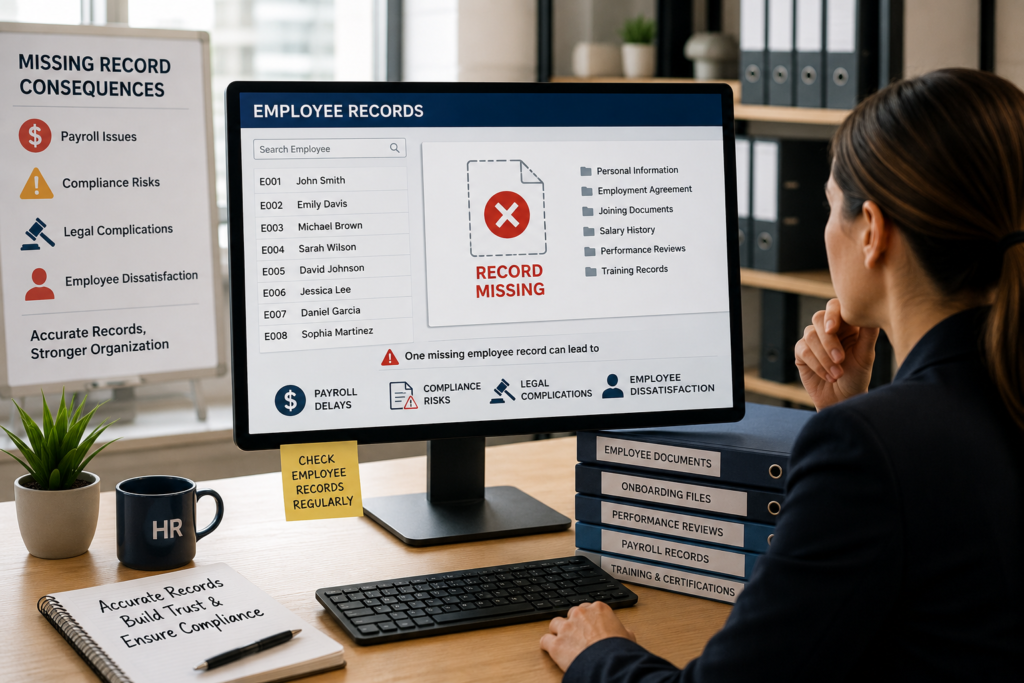
For HR professionals, every employee record tells an important part of the organization’s story. A single missing employee record may appear to be a minor administrative error, but its consequences can quickly grow into payroll disputes, compliance risks, legal complications, and damaged employee trust.
This story highlights how one missing employee record created unexpected challenges and why maintaining accurate employee documentation is essential for every HR department.
The Story: When an Employee Record Went Missing
Everything seemed normal until an employee requested copies of their employment history for a promotion process. The HR team searched the database only to discover that one employee’s onboarding documents had disappeared during a system migration.
The missing employee record included:
- Employment agreement
- Joining date confirmation
- Salary revision history
- Training records
- Performance evaluations
Without these documents, HR struggled to verify the employee’s service history.
Immediate Consequences
Payroll Verification Delays
Payroll calculations required manual verification, delaying salary adjustments and reimbursements.
Compliance Risks
Government audits require organizations to maintain complete employee documentation. Missing records exposed the company to compliance concerns.
Employee Dissatisfaction
The employee felt overlooked and questioned whether the organization truly valued their contributions.
Management Confusion
Managers were unable to confirm previous promotions, certifications, and performance milestones because supporting documentation was unavailable.
The Investigation
The HR team reviewed backups, emails, archived files, and paper records. After several days, they discovered that the employee’s digital folder had been incorrectly mapped during a software migration.
Although most documents were eventually recovered, https://vpassociatess.in/several files had to be recreated using payroll records and manager confirmations.
The process consumed valuable HR time that could have been avoided through better record management practices.
Lessons for HR Professionals
This incident reinforced several important lessons:
Maintain Multiple Backups
Store employee records in secure cloud storage along with offline backups.
Conduct Regular HR Audits
Periodic audits help identify incomplete or missing employee records before they become major issues.
Standardize Document https://vpassociatess.in/Management
Use consistent naming conventions and structured folders for every employee.
Automate Record Tracking
Modern HRMS platforms can alert HR teams when mandatory employee documents are missing.
Train HR Teams
Every HR professional should understand document retention policies and compliance requirements.
Best Practices to Prevent Missing Employee Records
- Create digital and physical backups.
- Verify records after every system migration.
- Schedule quarterly employee file audits.
- Restrict unauthorized editing or deletion.
- Maintain version history for critical HR documents.
- Use secure HR software with audit logs.
Conclusion
One missing employee record may https://vpassociatess.in/seem insignificant at first, but it can trigger payroll issues, compliance risks, employee dissatisfaction, and operational delays.
For HR professionals, accurate employee records are more than administrative files—they are the foundation of trust, compliance, and organizational efficiency. Investing in strong document management processes today can prevent costly problems tomorrow.
Leave a Reply