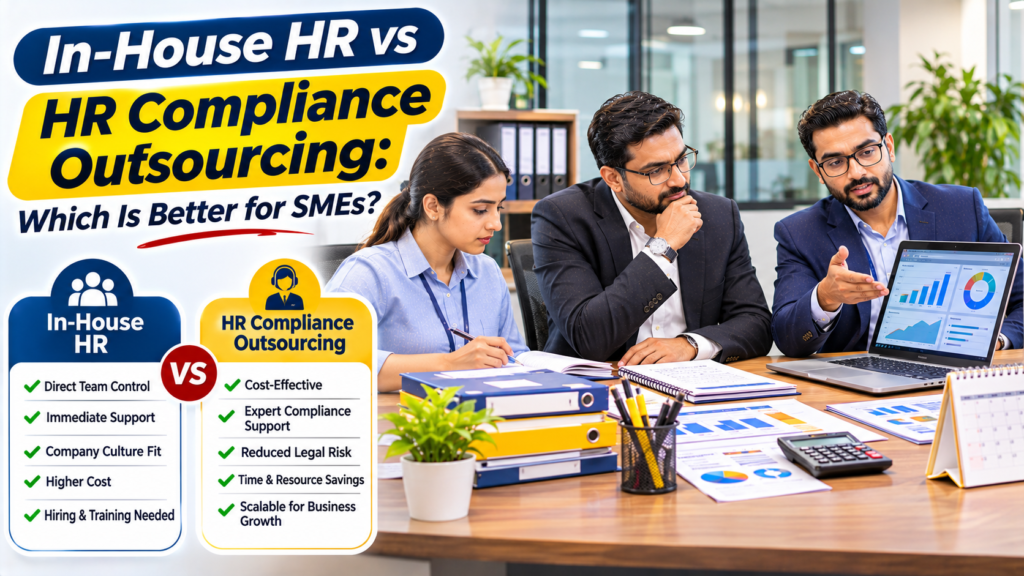
Managing employees is an important responsibility for every growing business. From recruitment and attendance management to payroll processing and statutory documentation, human resource (HR) activities require regular attention. For small and medium-sized enterprises (SMEs), handling these responsibilities efficiently can be challenging, especially when the business has limited staff, time, and resources.
One of the most common decisions business owners face is whether to hire an in-house HR professional or use external HR compliance outsourcing services. Both options have advantages, but the right choice depends on the company’s size, workforce, operational requirements, budget, and compliance responsibilities.
For businesses operating in industrial and commercial areas such as Sonipat, Kundli Industrial Area, Rai Industrial Area, Barhi Industrial Area, and IMT Kharkhoda, managing employee records, payroll, and applicable labour law requirements can become increasingly demanding as the workforce expands.
This guide explains the differences between in-house HR and outsourced HR, their costs, benefits, limitations, and the situations in which each model may be suitable for SMEs.
What Is In-House HR?
In-house HR refers to managing human resource activities through employees who work directly for the organisation. A business may hire one HR executive, an HR manager, or a complete HR department depending on its workforce and operational needs.
An in-house HR professional generally handles day-to-day employee-related responsibilities, including:
- Recruitment and employee onboarding
- Maintaining employee records and personal information
- Attendance and leave management
- Payroll coordination
- Employee communication and grievance handling
- Performance management and employee engagement
- HR policies and workplace procedures
- Coordination with management and department heads
- Maintaining relevant statutory and employment records
For example, a manufacturing company in Kundli Industrial Area may employ an HR executive to manage worker attendance, recruitment, salary coordination, leave records, and communication between employees and management.
The main advantage of this arrangement is that the HR professional works closely with the organisation and understands its employees, internal policies, and daily operations.
However, one HR executive may not have specialist knowledge of every area, particularly payroll regulations, labour law requirements, statutory filings, and compliance documentation. As a result, some businesses also need external professional support.
What Is HR Compliance Outsourcing?
HR compliance outsourcing means assigning selected HR administration, payroll, and statutory compliance activities to an external professional, consultant, or service provider.
Instead of hiring a full-time employee for every HR responsibility, a business receives specialised support for the activities it needs.
Depending on the service agreement, outsourced HR services for small businesses may include:
- Payroll processing and salary documentation
- Employee record management
- Attendance and leave data coordination
- HR documentation and appointment letters
- Applicable statutory compliance support
- PF and ESI-related administration, where applicable
- Assistance with employment policies and procedures
- Compliance calendars and documentation reviews
- Support with applicable returns, records, and filings
- HR process reviews and compliance reporting
For example, an SME operating near Barhi Industrial Area may already have an administrative employee who manages attendance and employee communication. However, the business may not have an experienced professional to coordinate payroll compliance and statutory documentation.
In this situation, the company can retain its internal administrative support while outsourcing specialised compliance activities.
It is important to understand that outsourcing does not automatically transfer every legal responsibility from the employer to the service provider. The business must still understand its obligations, provide accurate information, review work, and maintain appropriate oversight.
In-House HR vs Outsourced HR: Key Differences
Both models help businesses manage employee-related activities, but they operate differently.
The following comparison highlights the main differences:
| Comparison Factor | In-House HR | HR Compliance Outsourcing |
|---|---|---|
| Management | Managed by internal employees | Managed by an external service provider |
| Availability | Available according to working arrangements | Support available as agreed in the service contract |
| Salary Cost | Requires regular employee salary and related expenses | Usually involves an agreed service fee |
| Expertise | Depends on the experience of hired employees | Can provide access to specialised professionals |
| Recruitment | Internal HR team coordinates hiring | Recruitment support may be available if included |
| Payroll | Processed internally or with external software | Can be handled by an outsourced payroll team |
| Compliance | Internal team manages applicable requirements | External professionals provide agreed compliance support |
| Employee Communication | Direct interaction with employees | Usually coordinated through the company’s internal contact |
| Scalability | May require additional employees as operations grow | Services can often be adjusted according to requirements |
| Internal Control | Greater direct control over daily HR activities | Requires coordination and monitoring of the service provider |
There is no universal winner. A company with a large workforce and continuous employee-management requirements may benefit from an internal HR department. A smaller organisation with limited HR requirements may find outsourcing more practical.
Benefits of Having an In-House HR Team
An in-house HR department can be valuable when a company needs regular employee interaction and direct control over HR operations.
1. Direct Employee Communication
An internal HR professional can communicate with employees throughout the working day. Employees can approach the HR department regarding attendance, leave, salary queries, workplace concerns, and company policies.
This direct communication can help management understand employee concerns and address routine issues more efficiently.
2. Better Understanding of Company Operations
An in-house HR employee becomes familiar with the company’s departments, reporting structure, work culture, and employee requirements.
For example, a manufacturing business in Rai Industrial Area may have different employee-management requirements for production workers, supervisors, office staff, and management employees. An internal HR professional can develop a practical understanding of these differences.
3. Immediate Coordination
When a new employee joins, an existing employee resigns, or a department needs additional staff, the HR team can coordinate directly with management.
This can be useful for organisations that regularly recruit employees or manage multiple departments.
4. Greater Control Over HR Processes
With an internal HR department, management can directly supervise recruitment, employee records, performance reviews, internal communication, and HR policies.
The company can also establish its own procedures according to its operational requirements.
5. Support for Employee Engagement
In-house HR professionals can organise employee meetings, training sessions, performance discussions, and engagement activities.
These activities may become increasingly important as the organisation grows and develops a larger workforce.
Limitations of an In-House HR Department for SMEs
Although internal HR offers several advantages, maintaining a dedicated team can create challenges for smaller businesses.
1. Higher Fixed Employment Costs
Hiring an HR professional involves more than paying a monthly salary. The business may also need to consider recruitment expenses, training, software, office infrastructure, employee benefits, and other employment-related costs.
For a small business with a limited workforce, maintaining a full-time HR department may not always be financially practical.
2. Limited Specialist Knowledge
One HR executive may be responsible for recruitment, attendance, payroll coordination, employee documentation, and compliance-related work.
However, these activities require different skills and levels of expertise.
A professional who is experienced in recruitment may not necessarily have detailed knowledge of statutory compliance management or payroll-related requirements.
3. Dependency on One Employee
If the organisation depends on a single HR executive, their absence, resignation, or extended leave can interrupt important activities.
The business may struggle to maintain continuity if there is no backup employee or documented process.
4. Training and Software Expenses
HR processes frequently involve employee management systems, payroll software, documentation tools, and compliance-related updates.
The company may need to invest in employee training and suitable software to maintain efficient internal processes.
5. Difficulty Keeping Up With Regulatory Changes
Employment and labour compliance requirements can change through new laws, rules, notifications, and government procedures.
An internal HR employee must continuously monitor relevant developments and understand how they affect the organisation.
This can be difficult when the employee is already managing several operational responsibilities.
Benefits of HR Compliance Outsourcing for SMEs
For businesses that do not require a large internal HR department, outsourcing can provide access to professional support without building every function internally.
Here are some important HR outsourcing benefits for SMEs.
1. Access to Specialised HR and Compliance Knowledge
One of the major advantages of outsourcing is access to professionals who regularly work with payroll, employee documentation, and statutory compliance processes.
Depending on the provider’s expertise and service scope, an SME can receive assistance with applicable labour law requirements, compliance documentation, payroll coordination, and filing-related activities.
This can be particularly useful for business owners who do not have a dedicated compliance specialist.
2. Better Control Over HR-Related Expenses
Hiring a full-time HR employee creates a recurring employment expense. Outsourcing generally works through an agreed service fee based on the activities included in the contract.
For example, a small business may require payroll processing and compliance support but may not need a full-time HR manager.
Instead of hiring additional employees, the business can evaluate an outsourcing arrangement that covers those specific requirements.
The actual savings depend on the service fee, internal workload, employee strength, and complexity of the company’s requirements.
3. Reduced Administrative Workload
Business owners and administrative employees often spend considerable time preparing salary information, organising employee documents, maintaining records, and coordinating compliance-related activities.
HR administration outsourcing can reduce some of this workload by assigning defined activities to an external professional.
This allows internal management to focus more on production, customer service, sales, business development, and other operational priorities.
4. Support for Payroll Management
Payroll involves more than transferring salaries to employee bank accounts. It may include attendance calculations, salary components, deductions, applicable statutory contributions, payslips, and payroll records.
SME payroll outsourcing can help businesses organise these activities through a structured process.
An outsourced payroll professional can process salary information using the records and inputs provided by the company, subject to the agreed scope of work.
5. Flexible Support as the Business Grows
A small business may begin with a limited number of employees and gradually expand its workforce.
As employee strength increases, the organisation may require additional support for payroll, documentation, onboarding, and compliance administration.
Outsourcing arrangements can often be adjusted to cover additional services as the company’s requirements change.
However, businesses should confirm service capacity, employee limits, turnaround times, and additional charges before signing an agreement.
6. More Consistent Documentation and Reporting
An organised HR process depends on maintaining accurate employee records and supporting documents.
Outsourced professionals can help establish documentation procedures, maintain agreed records, prepare reports, and identify missing information.
This can improve visibility into HR operations and help management review important employee-related activities.
Limitations of HR Compliance Outsourcing
Outsourcing can be useful, but it is not automatically suitable for every organisation.
Before choosing an external provider, SMEs should understand the following limitations.
1. Less Direct Control Over Daily Activities
An external service provider does not work inside the organisation throughout the day.
Therefore, activities such as employee communication, workplace supervision, attendance monitoring, and immediate grievance handling may still require internal coordination.
2. Dependence on Accurate Information
An outsourced payroll or compliance provider generally depends on the company for employee details, attendance records, salary structures, leave information, and other necessary inputs.
If the business provides incorrect or incomplete information, the final output may also contain errors.
Both parties need a clear process for checking and approving information.
3. Communication and Response Time
An internal HR employee may be available for immediate discussions, while an outsourced professional may work according to agreed support hours and timelines.
Businesses should clarify communication channels, response times, escalation procedures, and the person responsible for urgent matters.
4. Employee Data Confidentiality
HR departments handle sensitive information, including employee identity details, salary information, bank details, employment records, and other personal data.
Before outsourcing, a company should review the provider’s data security practices, access controls, confidentiality terms, data retention procedures, and contractual responsibilities.
5. Service Scope Must Be Clearly Defined
Not every HR outsourcing provider offers the same services.
One provider may handle payroll processing, while another may offer broader HR administration and compliance support.
Businesses should avoid assuming that every statutory filing, registration, inspection response, or legal advisory service is included in a standard package.
HR Outsourcing Costs vs In-House HR Costs
Cost is one of the most important factors when comparing in-house HR and outsourced HR compliance services.
However, businesses should compare the complete cost of each arrangement rather than looking only at the monthly salary or service fee.
In-House HR Cost Components
An internal HR arrangement may involve:
- Monthly HR employee salary
- Recruitment and onboarding expenses
- Employee training and development
- HR software and technology
- Office space and infrastructure
- Employee benefits and applicable employment costs
- Backup staffing and continuity arrangements
These expenses may increase when the company needs multiple HR employees or specialist professionals.
Outsourced HR Cost Components
Outsourced HR compliance costs may include:
- Monthly or annual service fees
- Payroll processing charges
- Employee-based service charges
- Additional statutory filing or registration fees
- HR documentation support charges
- Special consultation or advisory fees
- Software or implementation charges, where applicable
Some service providers offer fixed monthly packages, while others calculate fees according to employee strength, the number of services, or the complexity of compliance requirements.
Which Option Is More Cost-Effective?
For a small organisation that needs only payroll processing, employee documentation, and selected compliance support, outsourcing may be more cost-effective than hiring a full-time HR specialist.
However, a company with frequent recruitment, employee relations issues, multiple shifts, and continuous workforce-management requirements may benefit from an internal HR employee.
The right approach is to calculate the total annual cost of both arrangements and compare it with the actual services the business needs.
Which HR Model Is Better for Different Types of SMEs?
The most suitable HR arrangement depends on the nature of the business and its workforce.
1. Small Businesses With a Limited Workforce
Small businesses with a relatively limited number of employees may not require a full-time HR department.
Their requirements may include salary processing, employee records, appointment documentation, and applicable statutory compliance support.
For these businesses, HR compliance outsourcing for SMEs can be a practical option.
2. Manufacturing and Industrial Units
Manufacturing companies often manage production workers, supervisors, administrative employees, multiple shifts, attendance records, and workplace safety responsibilities.
Businesses operating in Kundli Industrial Area, Rai Industrial Area, Barhi Industrial Area, Murthal Industrial Area, and IMT Kharkhoda may have complex workforce-management requirements.
An in-house HR executive can coordinate daily employee activities, while an external compliance professional can support specialised documentation and statutory processes.
This combination can help maintain internal coordination while providing access to specialist support.
3. Growing SMEs
A growing business may initially manage HR activities through its owner or administrative team.
However, as recruitment increases, payroll becomes more complicated and employee documentation requires greater attention.
In this situation, outsourcing selected HR functions can help the organisation establish more structured processes without immediately building a complete HR department.
4. Businesses With Multiple Locations
Companies operating from different locations may need consistent employee documentation, payroll processes, and HR policies.
An internal HR team can coordinate company-wide employee management, while an external provider may support selected payroll and compliance activities.
The company should ensure that state-specific requirements and establishment-related obligations are considered wherever applicable.
Is a Hybrid HR Model Better for SMEs?
For many small and medium-sized businesses, the decision does not have to be limited to in-house HR or complete outsourcing.
A hybrid HR model combines internal HR administration with external specialist support.
Under this arrangement, the company retains responsibility for daily employee coordination while outsourcing selected technical and administrative activities.
For example:
| HR Activity | Internal Team | Outsourced Professional |
|---|---|---|
| Recruitment coordination | Yes | If included in the service |
| Employee communication | Yes | Support if agreed |
| Attendance collection | Yes | Payroll input processing |
| Leave management | Yes | Documentation support if included |
| Payroll processing | Provides employee data and approvals | Processes payroll if contracted |
| Employee documentation | Collects and verifies information | Prepares or reviews agreed documents |
| Statutory compliance | Provides records and management approvals | Provides agreed compliance support |
| Compliance reporting | Reviews reports | Prepares agreed reports |
| Employee grievance handling | Yes | Specialist guidance if contracted |
This model allows business owners to maintain direct control over employees while receiving professional assistance for activities that require specialised knowledge.
For example, an SME in Sonipat may have one internal HR executive who manages recruitment, attendance, and employee communication. The company can separately engage a professional compliance service provider for payroll processing, statutory documentation, and applicable filing support.
The hybrid approach can be especially useful when the company wants to avoid unnecessary fixed costs but still needs organised HR operations.
Important Compliance Responsibilities SMEs Should Understand
Whether a business chooses in-house HR, outsourcing, or a hybrid model, applicable employment and statutory requirements must be addressed.
Depending on the establishment, workforce strength, nature of operations, wages, and applicable central and state rules, relevant responsibilities may include:
- Employee appointment and employment documentation
- Wage calculation and timely salary payments
- Attendance, working hours, and leave records
- Applicable minimum wage requirements
- Provident Fund-related obligations, where applicable
- Employees’ State Insurance-related obligations, where applicable
- Gratuity and other applicable employee benefits
- Maternity-related provisions, where applicable
- Workplace health, safety, and welfare requirements
- Applicable statutory registers, returns, and records
- Contractor and contract labour-related compliance, where applicable
India’s labour law framework includes the four Labour Codes, and businesses should review the provisions, applicable rules, notifications, and relevant state-level requirements that apply to their establishment.
For businesses operating in Haryana, compliance planning should also consider the applicable Haryana rules and notifications.
Importantly, hiring an external HR compliance provider does not automatically remove the employer’s statutory responsibilities. The organisation should verify that required activities are completed and maintain appropriate records.
How to Choose the Right HR Compliance Outsourcing Provider
Selecting the right service provider is important because HR and payroll activities involve employee information, financial records, and statutory responsibilities.
Before hiring an external provider, SMEs should evaluate the following factors.
1. Relevant Industry Experience
Check whether the provider has experience supporting businesses similar to yours.
A manufacturing unit may have different HR and compliance requirements from a retail store, consultancy, or IT company.
2. Clear Service Agreement
Ask for a written agreement that explains the services included, responsibilities of both parties, delivery timelines, fees, and additional charges.
The agreement should clearly identify activities that are not included.
3. Payroll and Compliance Expertise
Evaluate the provider’s experience with payroll administration, employee documentation, applicable statutory requirements, and compliance-related processes.
Ask how the provider verifies information and manages filing deadlines.
4. Data Security Practices
Confirm how employee information is stored, accessed, shared, and protected.
The agreement should include appropriate confidentiality and data-handling provisions.
5. Reporting and Communication
A reliable provider should have a defined communication process.
Ask whether the business will receive payroll reports, compliance updates, pending-document lists, and regular status reports.
6. Support and Accountability
Understand who will be responsible for handling queries, correcting errors, and escalating urgent matters.
A clear point of contact can make coordination easier.
When Should an SME Switch From In-House HR to Outsourcing?
A business does not necessarily need to replace its existing HR team to benefit from outsourcing.
However, certain situations may indicate that external support is worth considering:
- The company is spending too much time on payroll administration.
- Employee documentation is not maintained consistently.
- The internal HR team lacks specialist compliance knowledge.
- Statutory deadlines are becoming difficult to manage.
- The company is hiring more employees but does not want to expand its HR department immediately.
- Management wants professional support for selected HR functions.
- The business needs a more organised compliance review process.
If the organisation already has an effective HR department, outsourcing can still be considered for specialist activities that require additional expertise or resources.
HR Compliance Outsourcing Support for SMEs in Sonipat and Nearby Industrial Areas
Businesses operating in Sonipat and surrounding industrial locations often need structured employee administration and compliance processes as their workforce grows.
Industrial and commercial areas such as Rai Industrial Area, Kundli Industrial Area, Barhi Industrial Area, IMT Kharkhoda, Murthal Industrial Area, and Kharkhoda may include organisations with different workforce sizes and operational requirements.
Similarly, businesses in Ganaur, Gohana, Murthal, Kundli, Bahadurgarh, and Panipat may need support with payroll coordination, employee records, HR documentation, and applicable statutory compliance activities.
The requirements of every establishment are different. A business should first evaluate its employee strength, industry, work arrangements, existing HR structure, and applicable legal obligations before selecting an outsourcing model.
V.P. Associates provides an opportunity for businesses to explore professional HR and compliance support according to their organisational requirements. SMEs can review their current processes and identify the areas where external assistance may be useful.
To understand the services relevant to your organisation, visit the V.P. Associates website at https://vpassociatess.in/.
Frequently Asked Questions (FAQs)
1. What is HR compliance outsourcing for SMEs?
HR compliance outsourcing for SMEs involves assigning selected HR administration, payroll, employee documentation, and statutory compliance activities to an external professional or service provider. The exact services depend on the agreement between the business and the provider.
2. Is outsourced HR cheaper than hiring an in-house HR executive?
Outsourced HR may be more economical for businesses that need only selected HR services. However, the actual cost depends on employee strength, service requirements, provider fees, and internal administrative expenses. Businesses should compare the complete annual cost of both options.
3. Can a small business outsource payroll and HR compliance?
Yes. A small business can outsource selected payroll and HR compliance activities, provided the service provider offers those services and the arrangement meets the organisation’s requirements. The employer should continue reviewing records and fulfilling its applicable responsibilities.
4. What services are included in HR compliance management services?
Depending on the provider, services may include payroll processing, employee documentation, statutory compliance support, applicable PF and ESI administration, compliance reporting, and HR record management. Businesses should confirm the exact service scope before signing an agreement.
5. Does outsourcing HR remove the employer’s legal responsibilities?
No. Outsourcing does not automatically transfer or eliminate the employer’s statutory responsibilities. The business must understand its obligations, provide accurate employee information, monitor the service provider’s work, and ensure applicable requirements are fulfilled.
6. Is a hybrid HR model suitable for manufacturing companies?
A hybrid model can be suitable for manufacturing companies that need internal employee coordination along with specialist external support. The internal HR team can manage daily workforce activities, while an external provider can handle agreed payroll and compliance-related functions.
7. When should an SME consider HR administration outsourcing?
An SME may consider HR administration outsourcing when its internal team spends too much time on routine documentation, payroll coordination, or compliance activities, or when specialist support is required but a full-time HR department is not financially practical.
Conclusion
Choosing between in-house HR and HR compliance outsourcing depends on the size, workforce, budget, and operational requirements of an SME.
An in-house HR department provides direct employee communication, internal coordination, and greater control over daily HR activities. Outsourcing provides access to specialised support for selected payroll, documentation, and compliance responsibilities without requiring the business to build every function internally.
For many small and medium-sized enterprises, a hybrid HR model can offer a practical balance. Businesses can retain internal control over employees while outsourcing technical and administrative activities that require specialist knowledge.
Before making a decision, evaluate your current HR workload, annual expenses, employee strength, compliance requirements, and future growth plans. The right arrangement should support efficient employee management, organised documentation, and timely attention to applicable statutory obligations.
Disclaimer: This article is intended for general informational purposes and does not constitute legal advice. Labour law and statutory compliance requirements depend on the nature of the establishment, employee strength, applicable wage criteria, location, and relevant central and state rules. Businesses should obtain professional guidance for their specific circumstances.
Leave a Reply