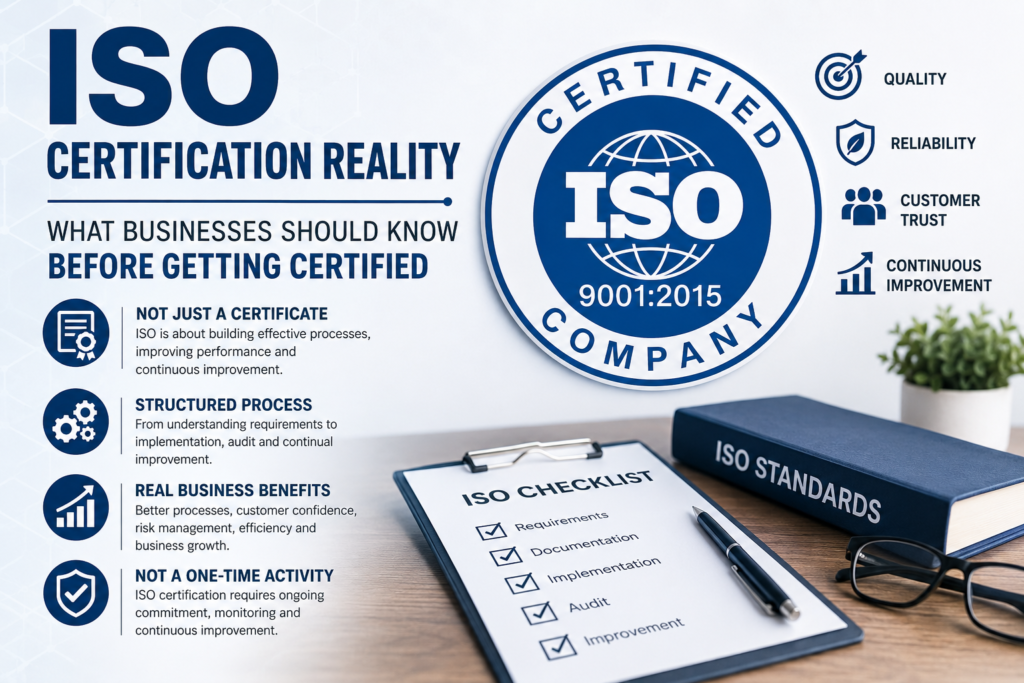
ISO certification is often seen as a symbol of professionalism, quality, and trust. Many businesses believe that simply obtaining an ISO certificate will automatically improve their reputation, attract customers, or help them win contracts.
But the reality of ISO certification is different.
An ISO certificate is not just a document to display on your office wall. A genuine ISO certification reflects that a business has established and follows a structured management system according to a particular ISO standard.
Understanding what ISO https://vpassociatess.in/certification actually involves can help businesses avoid common mistakes and make better decisions.
What Is ISO Certification?
ISO stands for the International Organization for Standardization. ISO develops international standards covering areas such as quality management, information security, environmental management, occupational health and safety, and more.
Some commonly used standards include:
- ISO 9001 – Quality Management System
- ISO 14001 – Environmental Management System
- ISO 45001 – Occupational Health & Safety
- ISO 27001 – Information Security Management
- ISO 22000 – Food Safety Management System
The appropriate standard depends on the nature and requirements of your business.
Myth 1: ISO Certification Is Just a Certificate
One of the biggest misconceptions is that ISO is simply about obtaining a certificate.
In reality, certification generally requires an organization to establish appropriate processes, maintain documentation and records, monitor performance, identify risks, address problems, and continually improve its management system.
A certificate without an effective system behind it may provide little real value.
Myth 2: Every ISO https://vpassociatess.in/Certificate Has the Same Value
Not all certificates should automatically be treated as equally credible.
Businesses should carefully check:
- Which ISO standard is being certified?
- Who issued the certificate?
- Is the certification body properly accredited where accreditation is required?
- Is the certificate within its validity period?
- Does the certificate accurately describe the organization’s scope?
- Are surveillance or follow-up audits applicable?
Simply choosing the cheapest certificate without checking its credibility can create problems later.
Myth 3: ISO Certification Means Your Product Is Perfect
ISO certification does not necessarily mean that every product or service produced by a company is perfect.
For example, ISO 9001 focuses on the organization’s quality management system. It is about having appropriate processes to consistently meet applicable requirements and improve performance.
Therefore, businesses should avoid making exaggerated claims such as “ISO certified means our product is guaranteed to be the best.”
What Does the ISO Certification Process Usually Involve?
While the exact process depends on the standard and organization, businesses commonly go through several stages.
1. Understanding the Requirements
First, the organization needs to understand the requirements of the relevant ISO standard and determine how they apply to its operations.
2. Gap Assessment
The existing business processes are compared with the requirements of the standard.
This helps identify areas that need improvement.
3. Documentation and Process Development
Depending on the standard, the organization may need appropriate policies, procedures, records, controls, responsibilities, and monitoring mechanisms.
The goal should not be to create unnecessary paperwork. Documentation should support the actual business process.
4. Implementation
The system needs to be implemented in day-to-day operations.
This is where ISO certification becomes more than a paperwork exercise.
Employees need to understand their responsibilities and follow the established processes.
5. Internal Audit
An internal audit can help identify non-conformities, weaknesses, and opportunities for improvement before the external certification audit.
6. Management Review and Corrective Action
Management should review the system’s performance and address identified problems appropriately.
7. Certification Audit
An independent certification body evaluates the management system against the applicable ISO requirements.
If the organization meets the requirements, certification may be granted, subject to the applicable certification arrangements.
The Real Benefits of ISO Certification
When properly implemented, ISO certification can provide meaningful business benefits.
Better Process Control
Clearly defined processes can reduce confusion, duplication, and avoidable mistakes.
Improved Customer Confidence
A structured management system can demonstrate that the organization takes quality, safety, security, or other relevant concerns seriously.
Easier Business Expansion
Documented and standardized processes can make it easier to train employees and maintain consistency as the organization grows.
Better Risk Management
Many ISO management standards encourage organizations to identify risks and take appropriate action before problems become serious.
Continuous Improvement
ISO systems are generally designed around monitoring, evaluation, corrective action, and improvement rather than simply achieving certification once.
Common Mistakes Businesses Should Avoid
Businesses often make mistakes when approaching ISO certification.
Choosing a standard without understanding the business requirement:
Not every company needs the same ISO standard.
Treating certification as a one-time activity:
A management system requires ongoing implementation and maintenance.
Creating excessive paperwork:
Documentation should be practical and relevant rather than created simply to satisfy a checklist.
Ignoring employees:
Employees are the people who actually operate the processes. Their involvement is essential.
Selecting a certification provider based only on price:
Credibility and suitability should be considered alongside cost.
Is ISO Certification Worth It?
The answer depends on your business objectives.
If customers, tenders, supply-chain partners, regulators, or industry requirements expect a particular certification, ISO certification may be commercially important.
Even when certification is not mandatory, a properly implemented management system can help an organization improve consistency, accountability, risk management, and customer confidence.
The key is to focus on building a useful management system rather than simply obtaining a certificate.
Final Thoughts
The reality of ISO certification is simple: the certificate is only the visible part of the process.
The real value lies in the systems, processes, controls, employee awareness, monitoring, and continuous improvement that support it.
Before pursuing ISO certification, businesses should identify the right standard, understand its requirements, choose credible certification arrangements, and prepare their organization properly.
ISO should not be treated as a wall certificate. It should become part of how your business operates.
Leave a Reply