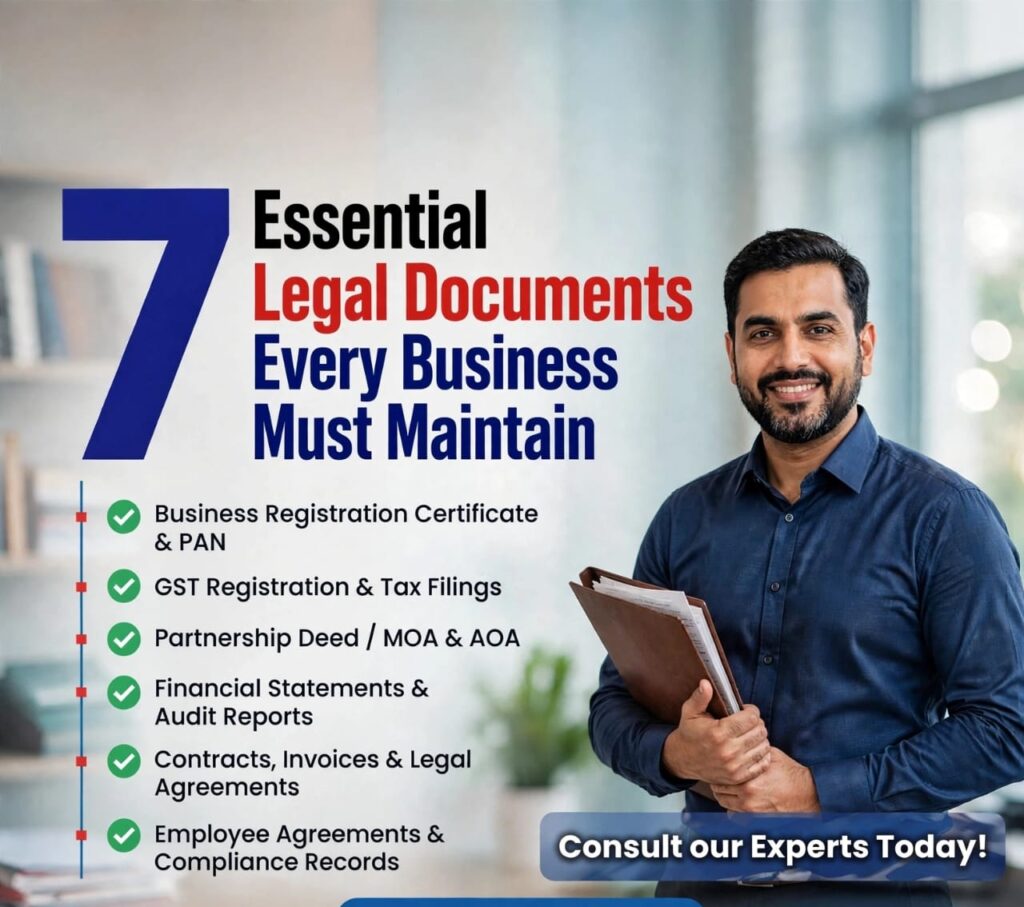
Here’s a professional, SEO-friendly blog for “Legal Documents Every Business Should Maintain”, written in simple language for business owners.
Running a business involves much more than selling products or providing services. Every business also needs proper documentation to protect its legal, financial, and operational interests.
Many business owners focus on sales, employees, and customers but overlook an important area—maintaining essential legal documents. Missing or outdated documents can create problems during audits, disputes, government inspections, funding, business expansion, or legal proceedings.
Keeping your documents organized helps demonstrate that your business is operating properly and can save significant time and money when important records are required.
Why Are Legal https://vpassociatess.in/Documents Important for a Business?
Legal documents provide evidence of agreements, ownership, compliance, transactions, and responsibilities.
Proper documentation can help a business:
- Prove ownership and authority
- Protect itself during disputes
- Meet regulatory and compliance requirements
- Maintain transparency with employees and customers
- Support tax and financial records
- Make business transactions smoother
- Prepare for audits and inspections
- Build credibility with investors, lenders, and partners
The exact documents required depend on the business structure, industry, location, number of employees, and applicable laws.
1. Business Registration Documents
Every registered business https://vpassociatess.in/should maintain documents proving its legal existence.
Depending on the business structure, these may include:
- Certificate of Incorporation
- Partnership Deed
- LLP Agreement
- Memorandum and Articles of Association
- Udyam Registration
- Shop and Establishment registration
- Other applicable registration certificates
These documents should be stored safely because they may be required for banking, contracts, financing, government registrations, and other business activities.
2. PAN, TAN and Tax Documents
Tax-related documents are among the most important records a business should maintain.
Businesses may need to keep:
- PAN documents
- TAN documents, where applicable
- GST registration certificate
- GST returns and supporting records
- Income tax returns
- Tax payment challans
- Tax notices and responses
- TDS records
- Form 16A and other applicable tax documents
Maintaining these records systematically makes tax filing and responding to tax notices much easier.
3. Licences and https://vpassociatess.in/Regulatory Approvals
Some businesses require specific licences or permissions to operate legally.
Depending on the industry, these may include:
- Trade licences
- FSSAI licence for applicable food businesses
- Factory licence
- Pollution-related approvals
- Fire safety approvals
- Professional or industry-specific licences
- Import-export related registrations
Businesses should also track expiry dates and renewal requirements so that licences do not lapse unintentionally.
4. Contracts and Agreements
Contracts define the rights and responsibilities of different parties.
A business should maintain copies of agreements such as:
- Customer agreements
- Vendor agreements
- Service agreements
- Lease or rent agreements
- Partnership agreements
- Distributor agreements
- Franchise agreements
- Non-Disclosure Agreements (NDAs)
- Employment agreements
Never rely only on verbal commitments when an important business relationship is involved. Written agreements can reduce misunderstandings and provide clarity if a dispute arises.
5. Employee-Related Documents
Businesses with employees should maintain appropriate employment records.
These may include:
- Appointment letters
- Employment agreements
- Employee identification and joining documents
- Salary records
- Leave records
- Attendance records
- Payroll records
- Performance-related documentation
- Resignation and relieving documents
- Applicable statutory records
Employee documentation should be maintained carefully and securely because it may contain confidential personal information.
6. Intellectual Property Documents
If a business owns a brand, logo, design, invention, software, content, or other intellectual property, relevant documents should be preserved.
These may include:
- Trademark applications and certificates
- Copyright registrations
- Patent documents
- Design registrations
- IP assignment agreements
- Licensing agreements
Proper documentation helps establish ownership and can become extremely important if someone copies or misuses the business’s intellectual property.
7. Financial and Accounting Records
Financial records are not only useful for accounting—they can also serve as important legal and compliance evidence.
Businesses should maintain:
- Invoices
- Bills
- Receipts
- Bank statements
- Payment records
- Expense records
- Financial statements
- Ledgers
- Audit reports
- Loan documents
- Investment records
Organized financial records make it easier to answer questions from auditors, tax authorities, banks, or investors.
8. Board and Ownership Records
Companies should maintain records related to their ownership and management structure.
These may include:
- Share certificates
- Shareholder records
- Board meeting minutes
- General meeting minutes
- Resolutions
- Registers required under applicable company law
- Records of changes in directors or shareholders
These records can become particularly important during investment, acquisition, restructuring, or ownership disputes.
9. Property and Asset Documents
Businesses should preserve documents related to major assets and properties.
Examples include:
- Property purchase documents
- Lease agreements
- Vehicle documents
- Equipment invoices
- Insurance policies
- Asset ownership documents
- Maintenance records where relevant
These documents can help establish ownership and support insurance or financial claims.
10. Insurance Documents
Business insurance can protect against several types of financial risks.
Businesses should maintain copies of:
- Insurance policies
- Premium payment records
- Renewal documents
- Claims
- Settlement documents
- Correspondence with insurers
It is also important to review policies periodically to ensure that coverage remains appropriate for the business.
11. Legal Notices and Correspondence
Never ignore or casually discard legal or government correspondence.
Maintain records of:
- Legal notices
- Government notices
- Tax department communications
- Labour-related notices
- Replies submitted
- Supporting documents
- Court-related correspondence
- Settlement agreements
A proper record of communication can be valuable when establishing what happened and when.
12. Keep Digital and Physical Backups
Maintaining documents is not enough—you also need to protect them.
A good document-management system can include:
Physical copies:
Store important original documents in a secure location.
Digital copies:
Scan important documents and store them in an organized digital folder.
Backup:
Maintain secure backups so that documents are not lost because of hardware failure, accidental deletion, theft, or other incidents.
Access to sensitive documents should also be limited to authorized people.
Common Mistakes Businesses Make
Many businesses make documentation mistakes such as:
- Keeping important documents in different locations
- Losing original agreements
- Not renewing licences on time
- Failing to update company records
- Not keeping copies of signed contracts
- Ignoring government notices
- Mixing personal and business documents
- Having no digital backup
- Giving everyone unrestricted access to confidential records
These mistakes may seem small initially but can create serious problems later.
How Often Should Business Documents Be Reviewed?
There is no single review schedule for every document. Businesses should establish a regular review system based on the type of document.
For example:
- Licences should be checked for renewal dates.
- Contracts should be reviewed before renewal or expiry.
- Employee records should be updated when circumstances change.
- Ownership and company records should be updated whenever there is a relevant change.
- Tax and financial records should be maintained according to applicable legal requirements.
A monthly or quarterly document-compliance review can help identify missing or outdated records before they become a problem.
Final Thoughts
Legal documentation is an essential part of responsible business management. Proper records can protect your business, demonstrate compliance, reduce disputes, and make important processes such as audits, financing, expansion, and transactions much easier.
Instead of waiting until a notice, dispute, or inspection occurs, businesses should create a systematic document-management and compliance process from the beginning.
Remember: A document that is difficult to find when you need it can be almost as problematic as a document you never maintained.
If you are unsure which legal and compliance documents your business should maintain, consider getting professional advice based on your business structure, industry, and applicable regulations.
Leave a Reply